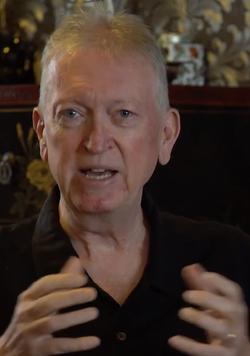
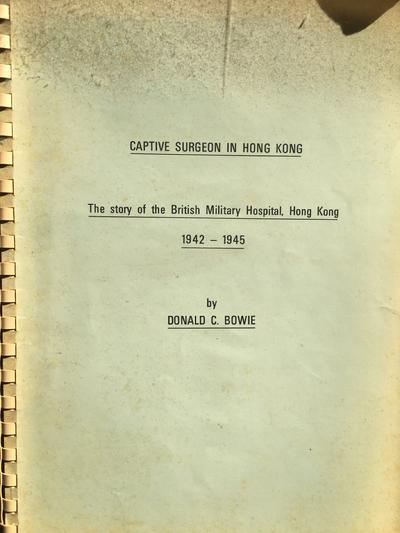
Welcome to Hong Kong War Diary - a project that documents the 1941 defence of Hong Kong, the defenders, their families, and the fates of all until liberation.
This page is updated monthly with a record of research and related activities. Pages on the left cover the books that have spun off from this project, and a listing of each and every member of the Garrison. Comments, questions, and information are always welcome. Tony Banham, Hong Kong: tony@hongkongwardiary.com
Image:
September Images
Christmas Day Penants, Hastilow & Young, Sir Mark Young's diary (all author)
Japanese POW Break (via John Dalton), Francis Noronha (courtesy Alberto Noronha), Tweed Bay 1943 (via John Dalton)
Mukden Memorial Ceremony, September 16 (all author)
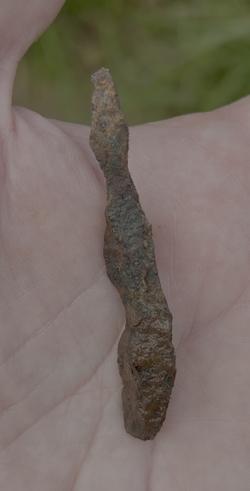
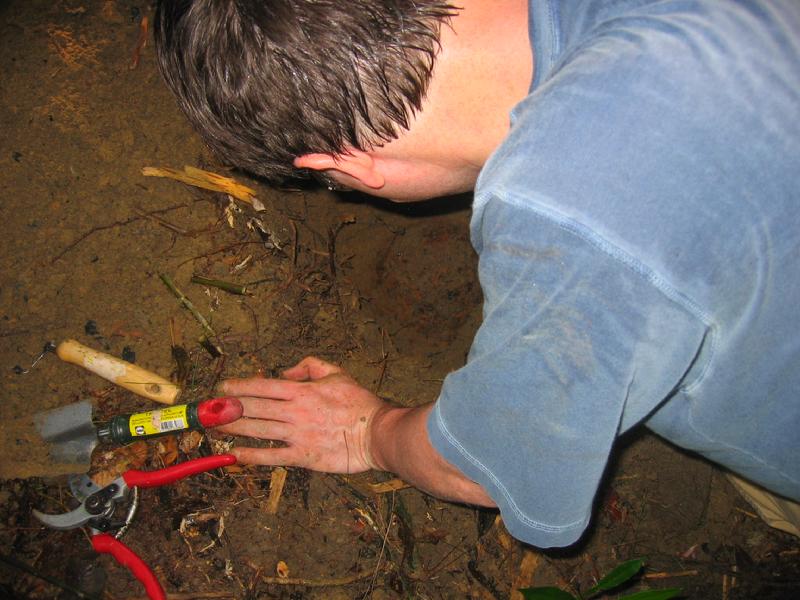
September News I spent almost half this month in Manchuria for the final production shoot of The Forgotten General. While this is primarily an American story, many British POWs were involved too and I was delighted to be joined by (among others) Tim Young, grandson of Hong Kong’s Governor Sir Mark Young, and Dig Hastilow, grandson of the Hong Kong garrison’s commander, General Christopher Maltby. It was the first time I’d met either, despite the fact that I’ve known Dig for 30 years on email and had previously met Tim’s sister and nephew! That project is now in post production, but is likely to be still occupying most of my time for the foreseeable future. 30 Heads up! The Royal Asiatic Society History Writing Competition for 2026/27 is likely to be announced earlier this year than last. Keep an eye on the website here. Last year we had 23 entries, and this year we expect even more. 29 CH Au posted this interesting 1945 film of Kai Tak and Japanese POWs. 27 Reading General Jonathan Wainwright’s original diary, I was fascinated to see that in Manila in 1941 he had received visits from Brigadier Reeve (commander of the Hong Kong Brigade until November of that year), ACM Robert Brooke-Popham and aide, and General Christopher Maltby. I suppose it makes sense that Allied commanders would want to get to know each other, but what surprised me is that Maltby’s visit was on 15 July 1941, four days before he took his post in Hong Kong! The implication, of course, is that he arrived in Hong Kong from the east. 26 Alberto Noronha posted a nice image of Private Franscisco Noronha, 6 Coy HKVDC, A.G.3 ‘Cornhill’, killed in action there on 18 December 1941. 24 Dig, who I re-met in Beijing on the way home, also very kindly gave me General Maltby’s scrapbook covering an officer POW reunion in Hong Kong in 1965. I only had time to take a look at it after I returned to Hong Kong this evening. There is a lot there I had never seen before, including original correspondence about ‘Red’ Bullen’s posthumous MiD. More on this next month. 23 Alexander Droft was able to find evidence that Azel Napoleon Ollsson (see last month) had indeed joined the HKVDC Engineers. A relative had written in the 1950s: “in addition to working on the air-raid shelters [he] was a member of the Hong Kong Volunteer Forces, but when the Japanese were in the final stages of capturing Hong Kong the acting Swedish Consulate General (a Britisher by the name of Mr. Miskin) advised my brother to discard his Volunteer uniform because my brother was a Swedish subject and Sweden a neutral country.” I checked the reprint of Hong Kong Volunteers in Battle and sure enough, there was an entry I had previously missed in the ‘did not enter POW Camp’ section, so now we have his serial number too: “4998 Sapper Ollson, A.N.” 22I spent most of the day in Liaoyuan Camp, where Tim Young kindly showed me his grandfather’s (Sir Mark Young) original diary. There is a museum on the site in a new building, and a large part of the original camp grounds have been preserved. However, while the right hand side of the long brick building perpendicular to the museum is genuine and pre-war, the building itself was only used as a store during the war. Although it has been rebuilt with cells and mannequins representing the senior POWs, the building in which they were actually held prisoner has been knocked down (though the foundation of part has been preserved and can be viewed under glass panels near the museum). 21 About one third of the Manchurian “away-team” transferred to Liaoyuan today. Here we will be filming the ‘boutique’ POW camp which held only the 16 most senior Allied POWs/Internees and their aides/orderlies/batmen. 20 On our last group day in Shenyang, Dig Hastilow kindly let me borrow both General Christopher Maltby’s ‘commonplace book’ (his POW scrapbook), and Air Vice Marshall Paul Maltby’s wartime diary. I had heard about the former from the family thirty years ago, but this was the first time I’d had the opportunity to look at it. Like many similar scrapbooks it contains verses and notes and – usefully – many signatures of fellow officer POWs. Paul’s diary was more factual and also contained lots of interesting data, though little (of course) pertaining to Kong Kong as he was captured on Java. Amazingly, Dig also brought with him the original pennants that flew on the small launch taking his grandfather and Sir Mark Young across Hong Kong harbour to the Peninsula Hotel to surrender the Colony to the Japanese. However, I already have so much material for this month that I think I’ll have to save the remainder of the Maltby content till October! 20 I heard back from Belinda Robinson today (see October 2025). She has made contact with Richard Harloe and they: “spent many hours discussing our families’ shared histories from Stanley and the Chinese Maritime Custom Service.” She is writing up the family history now. 18 Today I gave the closing address, via video, for IPLSA’s (International Probono Legal Services Association) side event at the 63rd session of the United Nation’s Human Rights Council in Geneva. In fact I was invited to attend in person, but was already committed to the Manchuria trip. 17 In conversation today I was recommended the film Love in a Fallen City, based on a book written in 1943 and set in Hong Kong during the war and Occupation. 16 John Slater posted an interesting image of Japanese POWs - no doubt feeling lucky to be alive - working at the Hong Kong Docks on 12 September 1945. John also posted a Japanese photo (possibly originally from Hong Kong News?) of Stanley internees on Tweed Bay beach in 1943. 16 This evening we returned to Mukden camp for a Memorial Service and candle-lit procession. At the service, each person who represented a POW spoke about them for a few minutes. 15 This morning the whole team took a bus to Mukden (Hoten) POW Camp. The team included families of POWs (American mainly, but also three British), families of Russians & Chinese who helped rescue them in 1945, and the son of one of the OSS guys who parachuted into co-ordinate things. We also of course had the film crew and a number of historical experts including Michael Hurst MBE from Taiwan, and Fuyuko Nishisato from the POW Research Network, Japan. This camp held, towards the end of the war, all Hong Kong’s most senior military officers. I spent some time pacing out the ground and concluded that the point where a B29 accidentally dropped a bomb into the camp, killing a number of men (two of whom were British, and are now buried in Saiwan) was outside the current museum grounds (as is the original camp hospital where one of the British actually expired, though the building itself remains). 14 At midday I took a brand-new Air China C919 to Beijing to transfer to the Domestic Terminal (always a hassle) for the connection to Shenyang. As expected, at the gate I met Sallie Ryan, granddaughter of Major Robert Peaty (while he was captured at Singapore rather than Hong Kong, he was Senior British Officer at Mukden [Hoten] POW Camp until AVM Maltby arrived). I am in Manchuria with a crew of around fifty people – American, British, Chinese, Russian, Taiwanese, and Japanese - shooting the last part of the big-screen documentary with the working title The Forgotten General. 12 The HKVCA published the autumn edition of their newsletter today. 7While walking on High West this morning I found a very definite shell splinter (illustrated), proving there are still some surface funds turning up. 5 Xinhua ran an article on Andy Salmon’s book today. 3 Ken Salmon emailed asking if I had come across any mention of his maternal grandfather, Jeronymo Francisco Da Silva, the Chief Accountant at the British Consulate in Macau during WWII (reporting directly to H.M. Consul, John Pownall Reeves). Ken notes: “He had worked in the Treasury Dept. of HK Government pre-war and I presume that's what helped him to secure the British Consulate position when he left HK for Macau with his seven children in early 1942. He had become a naturalised British Citizen but I suspect he used his Portuguese credentials to 'emigrate' to Macau. As an aside, he was quite tall and was hence a goalkeeper known as ‘Long John Silva’ who represented HK in Interport football matches. My late mother talked of the family providing safe haven, harbouring Allied personnel in their home in Macau at various times during the war. I'm therefore pretty sure that my grandfather would have been somehow involved in the more clandestine activities of the British Consulate, but I have no idea specifically regarding what he did other than, presumably, allocating funding as & when required.” I have seen mention of him in "The Lone Flag", but as far as I can recall, nowhere else.
September 1st, 2026 Update
Image:
August Images
3-inch AA Gun in HK (via Facebook), Kobe House photo & Explanation (courtesy Iain Gow)
Smith family medals (all courtesy Deirdre Swanney)
House by Jamia Mosque (author), Law newspaper clip (via Justin Ho), St Paul's Co-ed (author)
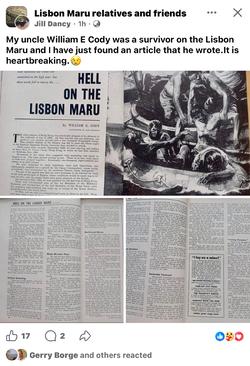
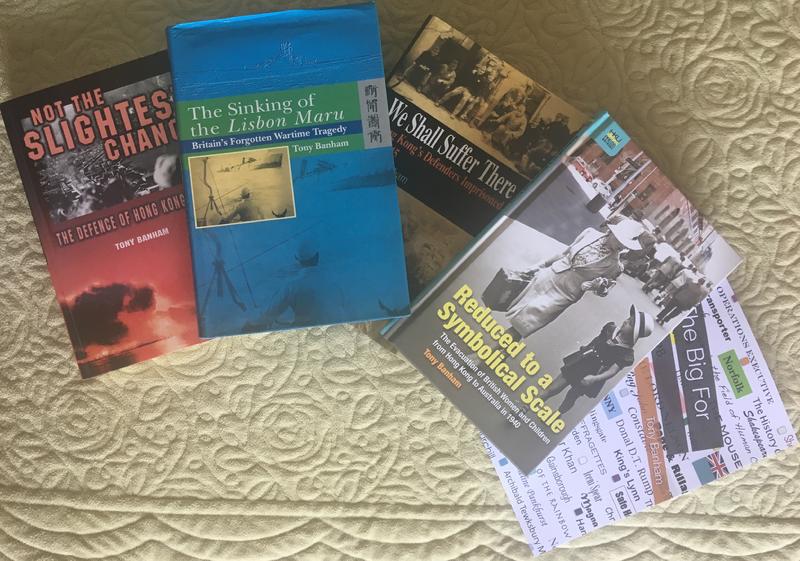
August News The publication of Courage of The Shadows (see the 28th) reminded me of the fifth and final book I am meant to be writing about the Battle of Hong Kong (working title: Noticeable & Dangerous, again from the famous Churchill quote). I have been compiling notes for it for nearly forty years, but something always comes up to prevent me focusing on completing it. It’s the story of the ‘secret’ war for Hong Kong: the spies and sabotage, the guerrillas, the escapes and escapees and what they did later, the Hong Kong Column of the Chindits, and BAAG – of course, they are at the heart of it all. Perhaps when my current researches on General Wainwright and the Pacific War in general come to an end, that will finally be the time to get this one finished. 30 Ken Salmon will be in Hong Kong in November, and it might be possible to arrange a Meet & Greet and book signing while he’s here (as a reminder, his father’s book Surviving the Lisbon Maru was published last month). Please email me if you might be interested in such an event. 29 I was contacted by a relative of the Korshoonoff family today, wanting to learn more about Arkady Korshoonoff (1908-1962) and Thelma Maria Korshoonoff (nee Webster). Arkady was a Russian member of the Hong Kong Police, naturalised to British early in 1941, and was therefore held in Stanley, but unfortunately I have very little information about him. 28 The book “Courage in the Shadows” was released today and I am looking forward to reading it. The subject is Phyllis Nolasco Da Silva (nee Anderson) who worked for BAAG. I also had a bit of a sneak preview of "Appendages of War" this month, the story of Joy Wilson, as it is being reviewed in the next Journal (Vol. 66) of the Royal Asiatic Society Hong Kong Branch – of which I am Editor - and am very much looking forward to reading it too. Amazing that two new books about BAAG, both featuring women agents, should come out almost together. I'll say more about Appendages of War when I get publishing details. 27 OK, this is a bit of a stretch but I’ve always been a fan of Don Henley’s Boys Of Summer (with, of course, the great Bruce Hornsby on keyboards), and by random chance today YouTube offered up Kt Tunstall’s version. It’s very good. And her grandfather was of course on the Lisbon Maru. 25 I asked Justin Ho if he could help with the Law Wai Tak question (see last month), and he turned up trumps. He and his colleagues checked newspaper archives and found a relevant article. He notes: “It turns out Law was with the Hong Kong Air Raid Precautions (ARP), renamed the Civil Aid Service (民安隊) post-war. In the Article, it mentions Law was a member of the ARP Dispatch Corps of the Eastern District (possibly on Hong Kong Island). His number was 518A and was promoted to Acting Senior Communications Warden by June 1941.” Hong Kong’s ARP story is truly under researched. Many of us have heard of Steele-Perkins (even though the story that name conjures up is probably unfair), and little else. I have an incomplete list of personnel, plus a few documents from Government files (The Corps of ARP Wardens Bill, and the ARP Ordinance), but not a lot else aside from odd mentions in books and articles with different main focuses. 25 I also heard today that I should finally be meeting General Christopher Maltby’s grandson next month! We have corresponded for a quarter of a century but never met… 24A correspondent is trying to find a book she recalls, about two prisoners of war who were on a prison ship – possibly Japanese – and escaped on a raft, though one died. It describes eating rotten turtle and having shark attacks. The closest Lisbon Maru story I can think of is Bill Spooner’s account of him and Mickey Myles on a raft, but that was only a short write-up – and of course the Lisbon Maru was only one of many hell ships. However, while we tend to talk about men dying in the sinking and the waters around it, I remain convinced that scores of men drifted away (eastwards) from the wreck on makeshift rafts or clinging to wreckage, and it could simply be an account like that that I have missed. 23 Iain Gow has found a very good view of Kobe House POW Camp in the context of Kobe town, taken from the roof of The Orient looking Northeast (the original was from a postcard, and can also be seen here). I have added a rectangle which incorporates the main camp buildings. He also kindly sent a diagram identifying each building. Around half the survivors of the Lisbon Maru were held here (including James Gow), hence the interest. 23 On the Lisbon Maru Facebook page, Jill Dancy posted a story about her uncle William E. Cody and the newspaper article he wrote about the sinking (illustrated). I have a copy of the original “Hell On The Lisbon Maru” from Wide World Magazine (which I received via Steve Denton in October 2019) if anyone needs it. I have lost track of how many survivors wrote stories about it for newspapers over the years, but there were quite a few. 17 With apologies to the original poster, someone (I forgot to note who) put a link to a photo of a 3 inch 20 cwt AA Gun on facebook. The original photo was dated 16 December 1941 and the caption said: 10980 ASSOCIATED PRESS PHOTO FROM NEW YOEK CAUTION: USE CREDIT On Guard in Hongkong A Sikh gun crew mans an anti-aircraft weapon at Hongkong, British Crown Colony 16 A London-based Swedish researcher contacted me about the Olsson family who lived at 6 Village Road, Happy Valley, during the Japanese occupation. Not only did they have Swedish - a neutral country – nationality, but the three brothers also had a Korean mother. 14The Lisbon Maru story continues to reverberate in China, with this new (I think) video being published in the news today. 11Douglas Smith’s (HKVDC) daughter got back in contact after a few years. She has her father’s medals and had some questions about them. She also noted: “There is also a single badge in the collection which I am very curious about. It says ‘To the Women of Australia’ and on the back has a serial number 202111. I have no idea who it belongs to. Last question (I promise!) is about a single medal which is from WWI and so it must be from my grandfather, Major James Smith who was captured in the fall of HK and a Japanese POW. I am not sure what the medal was for.” Not knowing much about medals, I passed the question to Steve Verrals who kindly responded: “The first set are the standard WW2 issue for HK servicemen and police: 1939-45 Star - for operational military service Pacific Star - for operational service in the Pacific theatre Defence Medal - for home (HK) defence War Medal - for military service In addition the last medal is the Territorial Force Efficiency Medal for long service on the reserve army, in this case the HKVDC. Note the clasp ‘Hong Kong’ making it the HK colonial issue. UK issues had a clasp ‘Territorial’. A scarce and desirable set of medals. You would know if Douglas Smith was a POW or not. The two medals to Major James Smith are the standard WW1 medals for active service 1916-1918, the British War Medal and Victory Medal. If Major Smith was also a POW HKVDC then he should in addition have similar medals to Douglas. As for the women of Australia badge. The ‘To the Women of Australia’ badge, officially called the ‘Female Relative Badge’, was a historic pin issued to the mothers, wives, and nearest female relatives of Australian service members serving overseas during World War I and World War II (source: Australian War Memorial). Maybe the wives were evacuated to Australia?” Both men were indeed POWs: Corporal Douglas Smith was on the fifth draft to Japan and Major James Smith (HKVDC, RE) stayed in Hong Kong POW Camps for the duration and his wife, Elizabeth, was evacuated. 11 Hopefully I will be meeting Sir Mark Young’s grandson next month. 8 The Jamia Mosque at Mosque Street in mid-levels was open to visitors today, and as I was coming up the escalator I decided to stop and take a look. I had been in the compound on an open day years ago, but I must have been in a hurry as that time I completely missed the large pre-war building behind it. There must be a story or two there, but unfortunately I don’t yet know anything about it. 5 I don’t often walk along MacDonnell Road in Hong Kong, but did so with my wife this morning. There are a few pre-war buildings on it which I should document properly, but for now I just got a quick shot of St Paul’s Co-ed College. 4Here’s a warning to fellow authors. In the past two months I have received three or four emails with this sort of language: “My name is XXXX, and I’m the organizer of the XXXX Book Club, a community of readers who come together to enjoy books, discover new perspectives, and share meaningful conversations around our reading experiences. We are delighted to reach out with an invitation to feature your book, The Sinking of the Lisbon Maru: Britain’s Forgotten Wartime Tragedy, as part of one of our upcoming book club sessions. Our members have selected your book as an upcoming read, and we’re excited about the opportunity to introduce your work to our community and explore this important and often overlooked chapter of wartime history. We would be honoured to feature your book as part of our reading programme. If you’re happy for us to move forward, a simple ‘Yes’ would be greatly appreciated.” These are of course scams. Apparently, if you respond they start asking for money for publicising the event and so forth… and of course the event never happens.
August 1st, 2026 Update
Image:
July Images
Sendai POWs (both courtesy Diana Young), Surviving the Lisbon Maru (via Ken Salmon)
Langley Bates medal (via Jonathan Ho), Geisha illustration (courtesy Trudy Crew), Screening at the House of Commons (via Hiu Man Chan)
Applebee Awatea records (author), Awatea Menu (courtesy Stephen Biggane), Torkildsen's MI9 file (courtesy Kristie Duchesne)
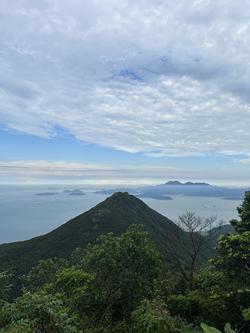
July News Apologies for the late update this month. I was travelling in Indonesia and the Philippines for much of July. There’s probably a PhD thesis in this for someone, on the story of why the Japanese placed certain civilian captives in military POW Camps, and certain military men in Civilian Internment Camps. In Hong Kong, for example, most policemen were in Stanley, but a few were in Shamshuipo and even on the Lisbon Maru. And in cases such as Private John Frelford of D Coy, 1st Middlesex, there was a whole (and somewhat heroic) story about why he ended up in Stanley. But this month (see the 27th) we finally have an explanation for the Stanley Platoon being held as internees rather than POWs. 31The Hong Kong Film Archive will be showing two free screenings of The Sinking of the Lisbon Maru on Sunday August 30, and Thursday September 3. Details and ticket information can be found here. 27 Lieutenant Cuthbert James Norman’s (CO of Stanley Platoon, HKVDC) daughter got in touch, with – at last – an explanation of how the Stanley Platoon (the HKVDC Platoon which comprised entirely warders at Stanley Prison) became interned at Stanley Civilian Internment Camp rather than as Military POWs in Shamshuipo. Normally, nominal civilians such as police or warders were interned as civilians unless they were captured on the front line – which was arguably the case at Stanley. However, she quoted his account of the incident which makes perfect sense: “we were conducted to the presence of a Japanese colonel in the grounds of St. Stephen's. Not surprisingly, we were not allowed into the buildings, which must still have been a shambles, and the interview took place under the casuarina trees. The colonel was polite, brief and to the point. He wanted to know how many prisoners were still in the prison, and how many troops and civilians had taken refuge there. Then he said that he was prepared to release temporarily all prison officers who had been fighting as Volunteers providing we would return to duty in the prison and carry on administration there until the Japanese could impose their own form of law and order. With St. Stephen's constantly in mind, and with a vision of what might happen to the defenceless people in the prison, I agreed at once providing it was clearly understood that my men would carry on their duties only so long as the prisoners were those sentenced under British law, and until proper arrangements had been made for the internment of civilians.” 27 On the FEPOW Family facebook page, Stephen Biggane noted: “My grandparents (Galina & Thomas Applebee) married in Tianjin, China in July 1939. Thomas was serving in the Royal Engineers. At the outbreak of war, the couple were evacuated to Hong Kong on the last ship out of the city with all remaining troops and their families. Then they were separated. Galia went on to the Philippines and Australia, where she would stay for the remainder of the war. Thomas was captured in 1942, when Singapore fell.” He was recently clearing his mother’s house and found a menu card from the Awatea. I have not seen one of these before, though was able to verify that the Applebees were on board. 26 Lance Corporal Frank Laurie Torkildsen’s (40 Fortress Coy., RE) granddaughter got in contact, hoping to learn more about his wartime history. It is complicated by the fact that his name is often misspelled in the records. His father was Norwegian and his mother Scottish and he grew up in Edinburgh, Scotland. The family believes that he was one of the men (like CQMS Fred Hamlen) that swam from the Repulse Bay area to Stanley. He was on the first draft to Japan, so was certainly not the type to give up easily! 25 Diana Young (see April and May), daughter of Gunner Trevor Jack Gould, 2 Bty, HKVDC, kindly sent me a number of photos and newspaper clippings about her father, and a transcribed copy of his diary. Gould was a New Zealander, and his family: Maisie, Josephine M. (age 4) and Francis D. (age 2)were evacuated from Hong Kong via Manila to Sydney on the Christan Huygens in 1940 and then made their way back to New Zealand. In the small group photo (both were taken at Sendai POW Camp), Gould is bottom left. He isn’t present in the larger group photo, but it is well worth reproducing here as we have the names, all Left to Right: Front row: Gunner William H. Mcgrath, RQMS Edward Patrick Casey, Gunner Raymond J. Englebrecht, CSM Stanley George Poole, Staff Sergeant Manassah N. Rakusen, Sapper Colin Mervin Cropley, Signalman Paul John Engelbrecht Second row: Sergeant Norman J. Bebbington, Sergeant Joseph Tausz, Private Eugene Max Joffe, Lance Corporal Joao Carlos Fonseca, Captain Patrick M. Cmeyla (U.S. Army), Gunner Carlos Arnulphy, Private Thomas Lock, Private Harry Luffkin Didsbury, Lance Corporal David Hynes, Private Theo Ralph Ingram Third row: Sergeant Willian Elijah Allen, Private Felix Fred Albert Dunnett, Private ‘Barney’ John P.B. Byrne, Sergeant James Patrick Rush, Private James Francis Buckley, Corporal Eric Leslie Groome, Private Fernand A. Engelbrecht Fourth Row: Gunner George Maurice Davreux, Gunner Lars Henrik Ongstad, Gunner Jorgan Vibe Christensen, Gunner John Connaughty Guthrie, Corporal Alec James G. Taylor, Gunner Per ‘Happy’ Dybdahl, Gunner Ragndald Riertsen, Private Constantine M. Wolosh, Corporal Harry Richard Darby Fifth row: Gunner Joseph Augustine R. Bowen, Private Charles Alec Allen, Gunner Karl J. Tomes, Sergeant Alfred Bertram Clemo, Sergeant George Stephen Winch, Gunner Norman Lionel Leonard, Lance Sergeant David John Leonard and Lance Corporal Frank Haynes. 24Jonathan Ho kindly let me know that eBay was selling the Long Service / Good Conduct Medal of Warrant Officer Clerk of Works Ronald Langley-Bates, RE. The site noted: “The solid silver army lsgc named 30877 WO CL II R L BATES RE. Verified English World War II prisoner of war groupings are scarce as their campaign medals were all issued (un)named so one needs a decoration or long service medal for attribution. Ronald Langley Bates (also known as Langley-Bates) was born in 1900. He may have been the same R L Bates who served in WW1. If he was his medals were certainly lost in the fall of Hong Kong although that MIC suggests they may not have been issued until 1951. He was posted to Hong Kong with his wife and two young sons. When war in the Pacific was imminent he had them evacuated to the relative safety of Australia - where they settled and lived until their deaths in the 1990s and 2014. Ronald was taken POW of the Japanese and was held in Hong Kong before being loaded on the Lisbon Maru. Tragically it was torpedoed by an American vessel and the POWs in the hold were not released by their Japanese captors. Ronald was amongst those who died. His POW card shows his wife living in Frankston Victoria. His family later claimed his un-named UK issued Pacific set of 4 medals in the 1990s. His son Doug has assisted in a number of papers regarding the plight of evacuees from Hong Kong and their lives in Australia.” Doug certainly assisted me a number of times, in both studying the Lisbon Maru and the 1940 evacuation of women and children from Hong Kong to Australia. 23 A family reached out to me today asking if I had any details about an ancestor who joined the HKVDC during the war, and was assumed lost. The name was Law Wai Tak 羅懷德, but I can’t find anyone of that name in my lists. Of course the British Army was hopeless at dealing with ‘foreign’ names, and their transliterations of Chinese varied constantly, but it’s still a bit odd. 23 Here’s something I haven’t seen before. On facebook Trudy Crew noted having a: “Napkin painted by a former Japanese guard in Stanley Camp and given to my dad. I understand the wording is from a song”. 16 The West Lothian Courrier ran an article about The Sinking of the Lisbon Maru being shown in parliament. 15Walking in Hong Kong’s hills this morning I bumped into Ron Taylor of The Royal Hong Kong Regiment (The Volunteers). I hadn’t realised until today that his uncle, Lieutenant Colonel Ronald Prestwich Taylor, had been killed in action in March 1945, late in the Burma campaign. 11 While much of Europe is seeing heatwaves and droughts, Hong Kong is having the wettest summer I remember. But today I was able to get up into the hills in a lull and took an atmospheric photo (illustrated) of High West from The Peak. Just a reminder of what Hong Kong looks like, for anyone missing it! 8 Ken Salmon let me know that his father’s book (edited by Ken) ‘Surviving the Lisbon Maru’ has been released. It can be found on Amazon here. 8 Peter Hall let me know that the KCC Roll of Honour for the two World Wars includes a “J W MacLeod”. The odd thing is that this can only be (it seems) Second Lieutenant James William MacLeod (or McLeod, depending on the source) who was in the HKDDC and was a POW at Shamshuipo for the duration. And yet he survived the war, so can anyone explain why he is listed here? To add further mystery, there doesn’t seem to be any record of someone with this name playing cricket in Hong Kong in the 1930s or 40s. 7 The Taiwan POW Camps Memorial Society published their Spring-Summer 2026 newsletter today. It includes mention of Fang Li’s visit to Taiwan to film for the Wainwright documentary. 6 The film The Sinking of the Lisbon Maru was shown at the House of Commons in London today, and discussed in parliament. 2 It’s surprising that reviews of The Sinking of the Lisbon Maru documentary are still appearing two years after the film premiered, but this one is reasonably fair. 1 Playing around on YouTube I found this nice (and short) documentary: Memories of Occupied Hong Kong.
July 1st, 2026 Update
Image:
June Images
Bill Lake's bio (courtesy the late Bill Lake), HKVCA medal (courtesy Justin Ho), Doris Cuthbertson photo (courtesy Brendan Murray)
IJN Isuzu (via Ed Low), Viewpoint book review, Huts 1 & 4 in Argle Street (both courtesy Elizabeth Key)
Douglas Villas plaque (author), Hofuku Maru sinking (courtesy John Duresky), HK Defence map (via Debbie Jiang)
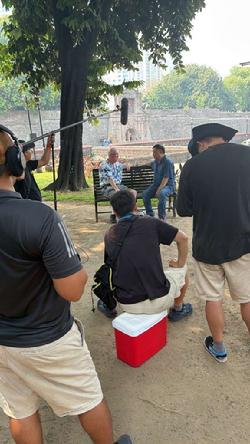
June News I was sorry to hear that Bill Lake passed away in the middle of the month, having battled serious health issues for some years. He was a stalwart of the Battle of Hong Kong scene, being a keen historian of the period, and having dedicated his time for many years to being the English-speaking MC at numerous memorial events. He always claimed to be ‘grumpy’, but in my experience seldom was. He had certainly lived a full life from his army days to being in more Kung Fu films than I could count – normally appearing as the corrupt – but Cantonese speaking – gweilo! Luckily for us, he was able to publish a biography just a few months back, which is well worth a look. 28 Debbie Lee Jiang notes on the Battle of Hong Kong facebook page: “Located inside the Book of Remembrance for the Second World War, these two are Decorative Pages that were hand-drawn by Alan Beddoe. These pages are shown on December 5 through 10 in the temporary Memorial Chamber (Room of Remembrance in West Block while renovations to Centre Block are completed).” I’m not sure if the dates refer to last year or this year, but am posting it here as I have not seen this map before. 26 EOD were called out at 4.52pm on Thursday to a suspicious object discovered on Pan Hoi Street in Quarry Bay. It turned out to be a very bomb-shaped rock! 25 While walking back up the Mid-Levels escalator before it turned directions this morning, I took a short cut (as I always do) and noticed a sign referring to Douglas Villas. There are many parts of Hong Kong with random steps, walls, and columns, and it was good to see a plaque explaining what the old steps I was walking up once was. There should be more of these! 21 I heard confirmation today that The Sinking of the Lisbon Maru film will be screened at the Houses of Parliament on Monday 6th July. 21 Brendan Murray writes: “A late family member of mine, Doris Cuthbertson, played a role in getting packages and messages into camps in Hong Kong during the Japanese occupation. It is our understanding that she was very close with Helen Ho who she considered to be the true heroine of Hong Kong. I am travelling to Hong Kong in the next couple of weeks. Would you be able to point me in the right direction towards any of Helen Ho’s descendants? This may be a long shot, but I thought I'd give it a go.” He kindly also sent a few photos. Luckily Doris Cuthbertson’s story has been documented by Brian Edgar and is available online here. However, I have never traced Helen Ho’s family and would be interested to hear if anyone knows them. 18Today I was sent a link to watch a version of the new documentary Under A Bamboo Sky, for which I provided some photographs. It’s about the 15,000 or so Australian POWs in the Second World War, told entirely in their own voices accompanied by what appears to be colourised original film of the period, AI-animated still photos of POWs as they were at the time, and some modern footage of the sites in question. In my opinion it works pretty well. 18 Ed Low posted an interesting photo of the Japanese cruiser Isuzu in Hong Kong in December 1941, on the Hong Kong Past – The Early Years facebook page. 17A different and very interesting article was published today, about the Lisbon Maru film. It starts: “China’s first documentary Oscar submission, The Sinking of the Lisbon Maru, demonstrates how ‘independent’ can become an economic designation divorced from aesthetic or political risk taking.” Apparently it was: “the second highest-grossing 2024 documentary worldwide behind Taylor Swift: The Eras Tour”. 12 I was sorry to hear that Bill Lake passed away today. He had been ill for some time and it was not unexpected. See his obituary here. 11 Elizabeth Key (see last month) kindly sent me a whole copy of the Shamshuipo magazine called Viewpoint. I hadn’t realised it was so long (it’s 48 pages!) She also kindly sent images of an eight-page book of drawings by Captain Godfrey Bird, including a nice one of huts 1 and 4 at Argyle Street POW Camp. It’s interesting that the book reviews in the magazine, quite logically, refer to volumes in the camp library. 11 While it’s not directly relevant to Hong Kong, today saw a major announcement about a Japanese hell ship. My American friend John Duresky, the discoverer of the wreck and a very serious researcher into the topic, noted: “The Hofuku Maru is lying in about 150 feet of water, at coordinates 15° 00.920'N, 120° 01.922'E about 2 nautical miles west of La Paz, Zambales Province, Philippines, as provided by the Sea Scan Survey team. It is split in half by at least one torpedo hit from an American plane, buried in silt up to the top deck, a mangled and torn up wreck with almost everything collapsed onto the deck or in the silt around it. By our estimates after reviewing a variety of POW statements, the Japanese records, and the records of the American pilots, the Hofuku Maru was hit by two torpedoes and at least one bomb. These mangled ship sections are the sacred Maritime Graves holding the remains of hundreds of UK, Netherlands and Japanese men.” He adds that around 800 of these men perished in the sinking and that the location has been wrongly identified since 1947 as being about 30 miles further north up the coast, and kindly supplied a fascinating photo of the attack that sank it. 8Ken Salmon let me know that the book about his father’s experiences, entitled Surviving The Lisbon Maru, should hopefully be published next month. 7 The HKVCA published their summer newsletter today. 5Justin Ho notes that he: “managed to acquire a photo recently, the veteran on the left is wearing a Military Medal, one of the 13 recipients.” He would be interested to know that man’s identity. He looks very familiar to me, but I can’t quite put my finger on it. 3 I returned to Hong Kong today to find a pile of post waiting for me, amongst which was a letter from Jennifer Dobbs. Jennifer has appeared in these pages before – her British father was killed in Hong Kong and her mother interned here, while Jennifer and her brother (both very young at the time) were accidentally abandoned in China. Jenifer’s book about this – Lost In China – is apparently selling very well in Japan! Over the years Jennifer has kindly passed me almost all her old Arthur Gomes Newsletters. I have a pile about three or four inches thick now, and one day must catalogue them properly. (By the way, that website is very much worth visiting - especially the gallery page). 2 China Daily today ran another article about the recent visit to Zhoushan of Lisbon Maru families. 1 Today was the last day of my filming trip to the Philippines, with a return to Intramuros with the Producer/Director Fang Li (illustrated). But I will be working on the remainder of this project until at least the end of the year. Interestingly, in a meeting that afternoon with two local historical experts (Desiree Benipayo and Tony Feredo), it turned out that Tony and I had worked together for a while in Manila – when we were both in IT – in 1994!
June 1st, 2026 Update
Image:
May Images
Arthur MacArthur's Hong Kong Nanny (via Internet), Naomasa trial (courtesy Colin Banfield), Ernest Simpson's MI9 form (via David Webb)
Author at WNCG (courtesy SCMP), Sai Ying Pun mass grave (courtesy Wallace Lai), 172nd Anniversary Dinner (author)
Three shots of US Navy bombing of HK Harbour (all via John Duresky)
May News Apologies for the late posting of this month’s update, but I was away for half of May helping shoot a documentary in the Philippines. My part was primarily studying the huge number of civilian massacres there, particularly in the last few months of the war (San Pablo Church, Lipa, Los Banos, Fort Santiago, and the others that added up to 100,000+ victims). While the Hong Kong massacres (The Ridge, St Stephen’s, Overbays, etc.) were primarily military, there were of course civilian massacres too – Blue Pool Road being perhaps the best known. But aside from massacres there were also thousands of executions and murders here in Hong Kong, and I was fascinated to read (see the 22nd) a new study of the mass grave of 2,632 bodies in George V Memorial Park in Sai Ying Pun. 31 Iain Gow notes: “Please find HERE the final link for the first edition of the Long Way from Home eBook. The book is entirely free (it’s on one of my cloud servers with no annual fee), and can be freely distributed as much as you like, the hope being it will spread awareness of the Zhoushan fishermen and their crucial role in saving the allied POWs from the ship. It should be mostly the same as the previous version, the differences being it now has an ISBN, we've inserted a stock statement about distribution, and put in a clickable link to allow anyone who wishes to donate! It seems to work having tested it with friends! The link takes you to the file directory, rather than trying to open the file immediately now. Enjoy!” It’s well worth a look. 28 I had an interesting email from David Webb, who noted: “Having worked in Singapore and visited the museum there I’ve long held an interest in the Japanese POWs. I was recently speaking to my brother about our upbringing in Greenwich, London and we started to recall many of our old neighbours. When we came to one of them we both recalled how it was whispered he was among those POWs, and the troubled life he lived.” That neighbour was Lance Sergeant Ernest George Simpson, of 5AA Battery, 7th Heavy AA Regiment. He kindly sent a copy of Simpson’s MI9 liberation form. Although I knew that he was on the third draft of POWs to Japan (the one following the Lisbon Maru) and had been liberated from Akenobe, I didn’t know that he had actually been captured in St Stephen’s Hospital. 25 I heard today that Atour Hotels (a well-known hotel chain in China) have purchased many copies of the Chinese version of The Sinking of the Lisbon Maru and are displaying them in every branch! 24 The South China Morning Post article about me was printed today and then appeared online. I was surprised how many people saw it! 24 Colin Banfield kindly got in touch noting: “My late father Lieutenant D.C.J. Banfield (The Buffs) served as an Advisory Officer for the British military courts that conducted War Crimes Trials in Hong Kong between 1946 and 1948. Please find some photos from his private collection which you might find to be of interest. Two of the photos cover the Behar trial (Oct 1947) at #5 War Crimes Court which show the proceedings in the courtroom with my father, the two defendants (Vice Admiral Naomara and Capt Haruo) and the tribunal. My father wrote a few words on the back of the photos to explain their significance. In addition there is also a photo of a site visit of the court to Shataukok on 8 September1947 with my father, Lt. Colonel Laming, Major Ormsby, the Japanese lawyer and interpreter and a prisoner and escort. I believe that Lt. Colonel R.C. Laming acted as presiding judge and that Major Ormsby was also judge as well as a prosecutor during various of the War Crimes Trials in HK. My father arrived in HK in 1946 and lived here until the mid-1980s before returning to the UK. He passed away in early 2021 aged 95 during the covid period.” Vice Admiral Naomasa Sakonju (he was more normally called Naomasa) was convicted by this British military court in Hong Kong for ordering the mass execution of 65 survivors from the sunken British merchant vessel, the MV Behar, in 1944. He was sentenced to death and hanged in Hong Kong on 21 January 1948. Captain Mayazumi Haruo was in command of the Imperial Japanese Navy cruiser Tone in March 1944, when she sank the Behar and captured the sixty-five survivors. As Rear Admiral Sakonju Naomasa gave the order for their execution, Haruo was given just seven years. 22 Wallace Lai Wai Lok kindly sent me a link to his and Kwong Chi Man’s new study of the mass grave in George V Memorial Park, Sai Ying Pun, from the Japanese occupation. It’s particularly interesting for me as – nearly forty years ago – I interviewed a witness to bodies being dumped there during the fighting (and also most Sundays I walk down Eastern Street, past High Street and Hospital Road, and that’s exactly the corner where it was. In the photo, ‘A’ marks the pit for the mass grave and the nearby long pits dug between December 1941 and January 1942). The gentleman I interviewed, Bill Bethell, was a child at the time and he said: “What did upset me a little bit was that there was a little, maybe a football field that had been dug up… and the PWD vans were picking up dead people on the streets, pulling in and just emptying the dead bodies into this hole. Now I’m convinced that while we were watching… some of those dead bodies weren’t dead. Whether it was movement of a dead body… there was movement amongst one or two of them. And I believe they covered them with lime.” 21 Chinese papers gave significant coverage to the current visit to Zhoushan by families of those on board the Lisbon Maru. This example is from Xinhua. 19 John Duresky, one of the team in the Philippines, kindly shared with me an incredibly high-resolution photo of a US Navy bombing attack on shipping in Hong Kong Harbour om 16 January 1945. One Grumman Avenger can clearly be seen at very low level. 17 I left for the Philippines today, for two weeks filming in Bataan, Manila, Batangas, and Laguna. 16 This evening I was the guest of honour at the Royal Hong Kong Regiment (The Volunteers) 172nd Foundation Day Dinner at Zetland Hall. Aside from a short speech about the Regiment, the Lisbon Maru, and the Second World War experience, my only role was to propose the final Toast of the evening ‘To the Memory of the Volunteers’ after my talk. 13 This afternoon I had a photo shoot with the South China Morning Post at Lawson’s HQ in Wong Nai Chung Gap, for a forthcoming biographical article. 13 Liz Key, daughter of Edward Peter Stevens of the HKDDC (see January) got back in touch. She notes that her father called it the Donald Duck Corps! 12 I needed to put together a CV in a hurry, and while doing so recalled the interview that Craig McCourry did with me a few years back. So I took a still image from it (illustrated) and put in a link to the interview when you click the photo. Try it! (Oops - I just did. And it didn't work from the photo any more!) 11 Louise Pullen on Old Hong Kong posted a very interesting Matilda Hospital aerial view on Facebook today. 10 Albert Parnell’s (RA) grandson got in touch. He notes: “He died several years ago and he never talked about his time. I know he was captured and was a pow and ended at Akenobe. I’ve received his army records which do not say a lot, I’m really trying to piece where he was in Hong Kong and what happened. His army number was 868798.” Parnell was in the RA 8th Coast Regiment, and I suspect he was 12th Battery though I am not certain. He was on the third draft of POWs from Hong Kong to Japan (the one that followed the ill-fated Lisbon Maru) and was held at Sakurajima (Osaka #4D, formerly Osaka #8B) and then Akenobe (Osaka #6B). His Osaka POW was number 6195, and Akenobe number 89. 8 In March I noted: “While working on the General Wainwright documentary I had a sudden thought. General Douglas MacArthur had a son called Arthur (born 1938 in Manila) whose nanny was a Chinese lady by the name of Loh Chiu (though also known as Ah Cheu). Many wealthy Americans in the Philippines pre-war preferred to import English-speaking Cantonese helpers from Hong Kong, and it turns out that this was where Loh Chiu was from. It’s a long shot, but I’d very much like to track down her family if anyone could help!” Now I have a good photo of her (above) if it helps anyone locate her. 2Steve Denton and I received a question from Ken Williams relating to the confusing fate of 851835 Gunner Charles Pragnell on the Lisbon Maru. The note in our master spreadsheet reads: “The Shamshuipo list states he was lost on the Lisbon Maru. Investigation shows that his POW Index Card indicates that on Showa 17 September 12 he died of chronic enteritis between 06.00 and 07.00. However, this is clearly in error as it continues: ‘Showa 17 September 27 transported to inland by Lisbon Maru. On the way, October 1, shipwrecked in East China Sea and assumed to drown. Shipwreck position: N30.17 E123.13’. The date of death has been muddled with Charles Fred Pragnel, HKVDC. RA casualty card has 12/9/42 Hong Kong Camp, Pow roster has 1/10/42. Index card has 12/9/42 but crossed out and lost on LM. I believe this to be a mix up on the index card and this man was mixed up with Charles Fred Pragnell who died in Shamshuipo. CWGC has U 12.9.42” In other words, this Pragnell was unfortunately lost on the Lisbon Maru.
May 1st, 2026 Update
Image:
April Images
Sir Mark Young (HK Museum of History, via author), Sir Mark Young's granddaughter and great grandson, Japanese HQ sign (both author)
Japanese War Memorial, PB57 (both via Old Photos Revisit), Never Forgotten (author)
Colonel Pigdon's death (author), Suicide Pact (courtesy Ian Quinn), Lisbon Maru's last track (author)
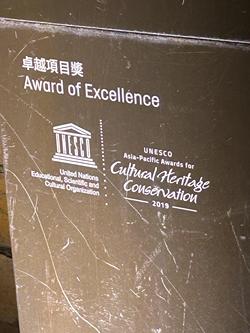
April News Over the years I have met or corresponded with Maltby’s family, and Lawson’s, Wallis’s, Hennessy’s, Gimson’s, and most of the other senior military and governmental figures who were in Hong Kong when the Japanese invaded. And of course in the old days I was in touch with a couple of hundred of the veterans themselves, and (by now) probably a thousand such families all told. So finally meeting elements of Sir Mark Young’s family (see the 27th) was a big deal, as it filled the biggest ‘missing part’ left in the puzzle. I realise that not every historian thinks that families are significant in this way, but for some reason I do! 29 The facebook page Old Photos Revisit showed a good colourised image of PB57 at Gillman’s Garage (the original black and white can be seen here too). Earlier posts on this page are also worth checking out. There was a fine one of the Japanese War Memorial near Mount Cameron (Bowen Hill, to be exact) the other day. 28 This evening saw the Royal Asiatic Society Hong Kong Branch have its AGM at the Hong Kong Club. There we presented awards to the winner and runner up of the newly-inaugurated History Writing Project. Their essays will be published in the Journal of the RASHKB later this year. Following this positive experience, I am sure that we will run this competition again in the autumn. 27 Today I had the pleasure of meeting Sir Mark Young’s granddaughter and grandson for the first time, and they kindly invited me to join their VIP Tour of The Hong Kong Museum of History. The reason for this is that The Hong Kong Story (a permanent exhibition) has been displaying a number of artifacts relating to Sir Mark since it re-opened on April 1st. I have to say that I was extremely impressed by the museum (not having visited for at least a decade), and especially by the helpfulness of the staff, and this particular exhibition. The Hong Kong Story alone occupies 4,000 square metres of the museum’s total of around 9,000 square metres of exhibition space. One of the surprises on display was the Japanese Occupation Headquarters wooden plaque. To quote the notice on the display cabinet: “Upon the arrival of Governor Rensuke Isogai in Hong Kong in February 1942, the Japanese forces set up the Japanese Occupation Headquarters in the Peninsula Hotel in Kowloon. In April of the same year, the headquarters was moved to The Hongkong and Shanghai Banking Corporation Building in Central. Isogai called on local calligraphers to write a plaque for the new premises of the Japanese Occupation Headquarters. Renowned seal carver and calligrapher Deng Erya was eventually selected and was reportedly rewarded with three bags of rice. After the end of the occupation, HSBC commissioned Chew Lee Building Contractor to take down the plaque, which was kept by the company’s owner.” Of course there is far more to the exhibition than just the Second World War, and it ends with a very effective full immersion experience of Hong Kong. I won’t put any spoilers here, but I very much recommend it. And it’s free! 26 Trevor Jack Gould’s (2 Bty, HKVDC) granddaughter got in touch. They have a diary and some photographs which I will hopefully be able to see shortly. He was on the sixth draft of Hong Kong POWs shipped to Japan, and was liberated from the Sendai #2B POW Camp there. You can see the liberation roster here. His wife Maisie, and children Josephine and Francis were part of the official civilian evacuation in July 1940, travelling on the Christiaan Huygens to Sydney. 23 I had a very interesting interview with a Hong Kong newspaper today. More about that next month. 21 I received the latest edition of the Java Journal today, and it mentioned that James Wren (a Royal Marine who had been on board HMS Repulse) passed away on 1 February 2026. As far as they know he was the last British forces FEPOW. He was 105. 21 Reading the POW diaries of senior American officers throws up the odd little snippet from the period they spent with their British equivalents. For example, Lewis Beebe at Shirakawa, Taiwan, in December 1943: “I am having Brig. Wallis (British) make an easy armchair for me. He is quite a clever workman.” 20 Ian Quinn kindly sent me a link to a video interview with a wartime child evacuee from Hong Kong. Unfortunately – although he looks rather familiar – no name is mentioned. Based on what we learn from the video (the interviewee was born three weeks before the evacuation, evacuated with his mother and no one else, returned to the UK in 1944, is Scottish, his father was interned in HK but survived the war (and was possibly an engineer), there are a dozen possibilities - but thanks to uncertainties in my data, I can’t narrow it down any further. Some of those possibilities are George Channing, Christopher Dowman, X Edwards, Graham Gardner, Richard Gilbert, X Hill, X Hurst, Richard Lambert, Keith Noble, Robert Paton, Hugh Peaker, and James Shepherd. 15 While reading the diary of American General William Brougher (captured in the Philippines) I found mention of the death of Colonel Pigdon, one of the Commonwealth officers (captured in Singapore) who died at Mukden Camp in Manchuria and was later reinterred at Sai Wan. My recent exposure to the Philippines’ wartime experience is making me take a more holistic view of these reinterments. 12 Today I received a copy of Michael Hurst’s book Never Forgotten. Michael effectively has ‘my job’ for Taiwan except that he has followed a different path, creating a society and focusing on ensuring that the memories of the POWs and POW Camps there are retained. The most senior of Hong Kong’s military POWs and governmental internees spent years in Taiwan on their way to their last camps in Manchuria. 9 While sitting outside Café Claudel at Tai Kwun waiting for a friend, I noticed a sign saying that the repurposing of the Police Headquarters Block – famously bombed during the Japanese invasion, and a popular stop when I show people around wartime Central - had won the 2019 UNESCO Cultural Heritage Conservation “Award for Excellence” (illustrated). I was a joint winner for that award in 2007, for helping with Crown Wine Cellars’ renovation of the Shouson Hill ordnance stores. 7 Ken Salmon, who now speaks regularly about the Lisbon Maru (which his father survived) asks: “In various discussions regarding the Lisbon Maru, I have been unable to give any definitive answer to a couple of quite basic questions as I have read several different answers in different journals: The first question is: ‘how far offshore was the Lisbon Maru when it was torpedoed?’ I've heard a variety of answers ranging from 6 to 20 miles. I wonder whether the distances quoted are from (1) the nearest island or (2) the Chinese mainland? The second question is: ‘How far was the Lisbon Maru towed before it eventually sank?’ The third question is: "how far offshore was the Lisbon Maru when it sank after being towed into shallower waters?’ I guess we know the precise location of the wreck so this should be an easy question to answer, but (again) I've heard various differing answers ranging from 2 to 6 miles. My stock answer is to say it is 3 kilometres due East of the northern tip of Qingbang Island (where the LM Memorial is), which seemed to be the most consistent answer quoted during my trip to Qingbang Island last year.” These are all good questions, and most are hard to answer with accuracy, but I thought I’d create a map showing the location where the Grouper claimed they torpedoed the ship (shown with the red dot), and the location of the wreck today (north east of DongJi). That at least gives some idea – though the accuracy of the Grouper data is questionable. I was also copied today on a video from Zhoushan, showing their museum which covers the sinking. 4 Iain Gow notes that he has created an updated version of the eBook Long Way From Home (about the Lisbon Maru, and families’ experiences visiting the site of the sinking). I need to check with him whether this version is now ready for general release. 2 Author Neil White – working on the Charlie Heather book – asked about “the Mount Fuji project undertaken by PoWs in Shanghai.” This is something I had only heard about from US POWs, so I pointed him at this answer. The POWs were told that the "Mount Fuji Project" was to build a children’s playground, but in fact they were constructing a rifle range. The butts were vaguely mountain shaped... 1 Following on from featuring the Roger Lamble (HKRNVR) items on eBay (see last month), I had a very nice email from the vendor – Jurassic Stamps. I have put him in touch with Lamble’s son and daughter. 1 Ian Quinn kindly sent a very strange cutting from The China Mail of 16 August 1947 describing a suicide pact allegedly made between eight POWs, including Lance Sergeant Melvin C. Roberts E/29898 of the Royal Rifles of Canada who was on the third draft of POWs to Japan. There are a number of things here that seem wrong, not least that Sendai #4B Ohashi, where Roberts was incarcerated, was liberated in September, not August. I was previously completely unaware of this story, but I see that the HKVCA have detailed it very well here and also quote people equally suspicious of the allegation.
April 1st, 2026 Update
Image:
March Images
Jack FitzHenry (courtesy Janine Gloria), Richard Marton, Marjorie and Malcolm Macpherson (both courtesy Emma Pruen)
Kai Tak 1938, Ship Street (both via facebook), Ponsford receipt (courtesy Shelyn Ponsford)
Lamble and two Camp Theatre Programs (eBay, Jurassic Stamps, via Justin Ho)
March News In my first career, at Shell in 1981, I was involved in CGI (among other things), developing hidden line algorithms for reservoir visualization in 3D, and even doing some simple computer animation for training videos. Only a few years later, GIS and CAD systems were available off the shelf, and then Photoshop and other such commercial tools appeared. A few years ago we became used to seeing high-fidelity colourised images of the Second World War (see the Ship Street example above), and that was great. The fourteen years between the end of that war and my birth had always seemed a much bigger gulf, as it was also (mainly) the period between ‘ancient’ black and white and ‘modern’ colour photography. So those colourised images were welcomed as making that period so much more ‘real’ and approachable. However, last week I was watching film of the Battle of Manila shot by the US Army in mid-February 1945, and it took me a while to realise that I was watching genuine colour 16mm, transferred to Technicolor 35mm. There were still sufficient clues to tell me, but now colourisation is blending with AI in ways that will soon fool even the experts. What had been image improvement is rapidly becoming image corruption, and it’s a worrying trend. 30 Justin Ho kindly sent me links to a number of items that belonged to the late Roger Dyrck Lamble, HKRNVR. Roger was a cadet, and one of the youngest members to become a POW. The items are: a Journey’s End camp theatre program, a Wavery Knavery theatre program, Lamble’s medical report, and a carved wooden box. The seller is Jurassic Stamps, and the full inventory can be found here. 29 Lt Col Balbir Singh (retd) is still very keen to find a photo of his father, Jemadar Balwant Singh, 7057, of the 2/14 Punjab Regiment in his 14th Punjab Regt uniform if anyone can help. 28 For the first time I am in touch with Sir Mark Young’s family, and in fact hope to meet them next month. It’s odd, really, as I have been in touch with Gimson’s family, and Maltby’s, Lawson’s, Wallis’s, and in fact the families of many – if not most - of the senior officers and government people for years, but not Sir Mark. And that despite the fact that our balcony looks right down at the Governor’s Residence! 26 Ian Quinn kindly sent me a full-page clipping from The China Mail of 21 January 1948 concerning the War Crimes Trial of Lieutenant General Ito Takeo. It describes various massacres (primarily of 3 Coy HKVDC personnel) at Jardine’s Lookout, and events at the ‘Black Hole’, Eucliffe, and the Repulse Bay Hotel. The latter includes reference to Sister Mosey’s heroic act: “G.P. White of No. 2 (Scottish) Coy. HKVDC said that on Dec 20 he was at the Repulse Bay Hotel. Covering fire was given to troops moving from the garage to the hotel and the enemy was eventually driven from the garage. Witness said that he was wounded in the left foot and together with a lance-corporal was told by a Sister in the hotel to strip off their uniform when the Japanese came. They gave up the Hotel and when the Japanese lined him up with others, Sister Mosey came in front of the bayonet and told the Japanese that witness was a sick man.” George White was of course really in 3 Coy, but this article contains several such errors. 25 The Facebook page “Old photos revisit” (sic) today posted a very nice set of colourised wartime photos of Hong Kong. Some are quite well known, but others I hadn’t seen before. These included a great photo of Kai Tak in 1938, and of Ship Street in Wanchai – which was of course the final street held by the Middlesex and odds-and-ends at the time of the Christmas Day surrender. 18 I received an alert today that Dongji Rescue can be watched online here. That doesn’t mean I recommend it; I’m just passing the information on! 17 Sanitary Inspector Eric Ponsford’s (Stanley Internee) granddaughter got in touch. I was able to share with her a couple of pages of the 1935 and 1938 Government Establishment reports showing her grandfather’s pay and leave status, and in return she kindly sent me his Provisional Statement of Full Pay Leave from liberation. Ponsford shared Stanley Block 9 Room 12 with nine other men: Frelford, John George British 12.09.15 Shop Asst (Soldier) Gill, Dennis Maxwell British 05.03.14 Wireless Engineer HKG Gutteridge, Frank John R. British 05.05.86 Chinese Maritime Customs Harbottle, Allan Vivian British 16.10.93 Wireless Officer Hill, James British 26.01.87 Marine Engineer Ponsford, Eric Norman British 20.06.03 Health Inspector Rolland, Thomas Bewick British 21.11.09 Wireless Officer Shaw, George William British 23.10.18 Radio Off. Merchant Service Stynes, John British 01.08.94 Chinese Maritime Customs Town, James Capt British 07.08.90 Master Mariner John Frelford is of course particularly interesting – and well known to readers of this site - as he was actually a serving soldier in the Middlesex regiment, and not a civilian! The Japanese let him be interned in Stanley instead of a military POW camp (in which of course, conditions were far worse) because - uniquely - he saved the life of a Japanese soldier during the fighting. 16 I was walking up Chatham Path this morning, as I typically do around four times per week, and grabbed a quick photo (illustrated) of No 1. It was built as a private house in 1926, and at the start of the war was the home of Alfred and Elizabeth Humphreys. They were both interned at Stanley where Elizabeth died at Tweed Bay Hospital on 8 May 1943. I still haven’t discovered who lived there during the Occupation, but it is generally assumed to have been the residence of a senior Japanese officer. Post-war it became a private secondary school, which closed in the early 1970s. It’s still occupied by live-in staff, but I’m not sure if there’s a family resident there at the moment. 11 A British M36 hand grenade was reported to the police today, apparently having rolled down a slope on Stubbs Road by the Hillside School. 10 Jack Cooper FitzHenry’s (Superintendent of the Fire Brigade Hong Kong) family got in touch again – see last month – kindly sending a fine photo and letting me know that unfortunately his medal for gallantry was sold by someone thirty years ago: “An exceptionally rare Colonial Fire Brigades Medal for gallantry awarded to Superintendent Jack Fitz-Henry - Hong Kong Fire Brigade COLONIAL POLICE MEDAL FOR GALLANTRY, Fire Brigades issue, G.VI.R., 1st type (Supt., Hong Kong Fire Brigade) contained in its Royal Mint case of issue, really extremely fine. Footnote C.P.M., London Gazette, 12th December, 1939, Jack Cooper FitzHenry, Superintendent of the Fire Brigade, Hong Kong. The report of the Chief Officer 1939 states His Majesty the King was pleased to award the Colonial Fire Brigades Medal to the Superintendent, Mr. J.C. Fitz-Henry- for gallantry on the occasion of the serious fire at Connaught Road West during a typhoon on 2nd September, 1937. Hong Kong was hit by a severe typhoon with winds reported at 164 m.p.h. The death toll exceeded 100 with the heaviest loss of life caused by the fire at Connaught Road. The Fire Brigade, under Mr. Fitz-Henry- fought for several hours during the height of the typhoon before the fire was brought under control. Fitz-Henry-was captured at the fall of Hong Kong and interned by the Japanese at Stanley Internment Camp. On his release he served as Chief Fire Officer but retired shortly after. during the present reign up to 1979. Only 2 Colonial Fire Brigades Medals for gallantry were awarded in the period ending 1952. A further 15 awards have been made since.” They also noted that Jack’s wife Olive was pregnant when she was evacuated, and a daughter (Dianne Ruth Fitzhenry, born 31 October 1940) was born in Sydney. I have lost count of the number of evacuee babies born like this in the Philippines and Australia, but I think I must have come across between 10 and 20 examples by now. 7 The HKVCA published their latest newsletter today. 5 Well known China commentator Arnaud Bertrand tweeted about the Lisbon Maru today. 4 While working on the General Wainwright documentary I had a sudden thought. General Douglas MacArthur had a son called Arthur (born 1938 in Manila) whose nanny was a Chinese lady by the name of Loh Chiu (though also known as Ah Cheu). Many wealthy Americans in the Philippines pre-war preferred to import English-speaking Cantonese helpers from Hong Kong, and it turns out that this was where Loh Chiu was from. It’s a long shot, but I’d very much like to track down her family if anyone could help! 2Iain Gow let me know that he and Janette have produced an eBook version of “Long Way from Home”. He notes that: “The aim is to eventually make this available free of charge through Open Access publishing, to encourage wider distribution and access.” 1 Continuing the Macpherson story (see last month), the family sent me a wonderful photo of Marjorie and Malcolm, and of a friend’s newborn son. This was Mrs Ann Marton, wife of Lance Bombardier Oliver Egerton Marton, of 2nd Battery HKVDC, who (again) was evacuated while pregnant. My notes show that she was evacuated by herself but returned from Sydney to the UK on 19 July 1945 together with her son (who, clearly, must have been Richard). 1 Lee Fook-Kee’s (RHKNVR) grandson got in touch noting that: “he said he fought the Japanese at Repulse Bay, so I can only assume he became a foot soldier after the scuttling of most vessels in Deep Water Bay.” Lee was a Leading Signalman who served on APV St Aubin at some point pre-war. He escaped to Free China, reporting to the BAAG in Kweilin in early June 1942, but didn’t stay for long and joined the KMT and under SACO. He was interviewed by Chinese press here and here.
March 1st, 2026 Update
Image:
February Images
Doc Ride's placemats (author), St Albert's Convent (via Richard Wong), Jemadar Balwant Singh (courtesy Lt. Col. Balbir Singh)
WNCG Police Post, PB3 entrance (both author), Sai Wan Fort (courtesy CH Au)
HK Club Walkers (courtesy Sanjay), HK Harbour at dawn (author), Fenwick's Medals (eBay via Justin Ho)
February News The Macpherson story (see the 25th) is a reminder of how much people in those days relied on ocean travel. Air travel was of course in its infancy then and catered to a wealthy minority. Almost everyone travelled by steamer, and the pages of the South China Morning Post (for example) were full of advertisements for this shipping line and that. In practice this was true globally at the time for journeys where rail was not an option, but is more obvious in isolated Colonies like Hong Kong (or the Philippines, for that matter) with their never ending requirements for long distance travel. 27 David Horsman, nephew of Gunner John Hugh Lane, has kindly continued to send me copies of letters that Lane wrote home. While nothing earth-shattering, I am learning some fascinating little details of garrison life. For example, this excerpt from a letter believed to be from autumn 1938 from Stonecutters Island: “Back at Stonecutter after being in hospital with a bad dose of Malaria. Temperature up to 104. Not allowed to eat for 5 days then chicken, salad, fruit and a bottle of Bass in the evening!” Malaria was always said to have been a common cause of hospitalisation in those years, but it’s nice to see Bass being prescribed as a medication! 25 While reading the December 1941 diary of an American officer in Manila, I noticed a reference to the wife of Lt Col Robert Macpherson of the RAOC who was later shot dead by the Japanese while trying to surrender The Ridge on 22 December. I checked with the family, and this turned out to be another case of a Hong Kong based couple, separated by the July 1940 evacuation to Australia, who managed to meet up ‘half way’ in the Philippines when the husband managed to get some leave. This is the third or so example I’ve come across. 23 Several news outlets today carried articles (Bastille Post, China Daily) about the Chinese New Year reception held at the Chinese Embassy in London on Saturday commemorating the Lisbon Maru. 22 This morning we held the last Hong Kong Club historical walk of the season. This time I took them for an easy stroll the length of Bowen Road. I often think there’s not much to see or talk about on this route, but in the end there was so much that we finished the walk 15 minutes late! Unfortunately the undergrowth – which has normally reduced a little by this time of year – and the ever-growing buildings have partially blocked some of the views that were still clear 15 or so years ago when I first developed this walk (one of these – oddly enough - being the shell splinter damaged stone bridge where Fenwick was presumably killed; see the thirteenth), but there was still plenty to see. It’s surprising that although many of the attendees used the route frequently, they had often previously missed things like the “War Department No. 1” marker (illustrated) by the steps up to the Bowen Road Hospital. The walk ends near the site of another hospital – the St Albert’s Monastery emergency hospital – and while preparing for the walk I found a photo of it on the Internet that I hadn’t seen before. What an imposing building it was, and later of course it was the Rosary Hill Red Cross Camp. Afterwards, Sanjay (the organizer at the Club) kindly sent me a photo of the group. 18 I needed to look something up on the late Roger Mansell’s website today and immediately saw that it has been nicely revamped and cleaned up by Wes Injerd under the name: Allied POWs Under the Japanese (APUJ). It’s still the best general website for FEPOWs, and while it is largely based on content from the US Archives in Maryland there is a lot of other data there too (and the US data, particularly the liberation rosters, is extremely useful). 18 Some fascinating old photos of Sai Wan Fort were posted on Facebook today. 18 My wife hosted a Chinese New Year lunch party for some friends today, and – as usual for special occasions – she brought out Brigadier Sir Lindsay Tasman Ride’s old Chinnery painting placemats (a kind present from Elizabeth Ride a few years back)! 15 I heard today from Roy Fitzhenry, who was evacuated in 1940 along with his mother Olive and older brother John. Roy was seven years old when they arrived in Australia. John was 16 and returned to Hong Kong a year later, joining the HKVDC as a gunner and thus becoming one of the youngest POWs. He was sent to Japan on the third draft of POWs. He was in the well known Hiroshima #5B Innoshima POW camp and appears in the equally well known photo of the ‘Genki boys’ in front of an Avenger on the aircraft carrier bringing them home in 1945. Jack Cooper Fitzhenry, Roy and John’s father, was Superintendent of the Hong Kong Fire Brigade and interned at Stanley. Jack stayed in Stanley for the duration, sharing room 10/30 with a number of other government employees: Fitzhenry, Jack Cooper British, 25.10.93, M, Fire Brigade, Stanley, 10/30 Hume, Donald William British, 14.07.91, M, Engineer, Stanley, 10/30 Mills, Laurence Langley British, 16.12.90, M, Retired, Stanley, 10/30 Mulcahy, Wilfred British, 14.11.03, M, Education Dept, Stanley, 10/30 Philips, Denis William British, 16.09.99, M, Health Inspector, Stanley, 10/30 Plumb, Bert British, 07.06.96, M, Prison Department, Stanley, 10/30 Tate, George William British, 05.11.91, M, Works Manager, Stanley, 10/30 Waid, John British, 01.11.91, M, Foreman, Stanley, 10/30 Ward, William John British, 28.02.92, M, Prison Department, Stanley, 10/30 Wilfred Mulcahy of course would retire as headmaster of the Central British School / KGV. 13 Justin Ho kindly let me know that Lieutenant Michael Fenwick’s, Royal Scots, medals are for sale; though I always find that rather sad. Here’s the relevant entry about him from Not The Slightest Chance, on 19 December 1941: “07.00 Lawson telephones Lieutenant-Colonel White (commanding Royal Scots in Wan Chai) and tells him that his HQ is surrounded. Thirteen minutes later, White sends Captain Kenneth J. Campbell’s Royal Scots A Company in trucks up Wong Nai Chung Gap Road. The trucks come under fire (with Campbell and Lieutenant Colin Hart being wounded, and Lieutenant Michael Fenwick killed) and the troops continue on foot, fewer than a dozen reaching Lawson (Shrapnel damage, still clearly visible on both sides of a stone bridge just south of 34 Stubbs Road, is most probably from this ambush). These include Sergeant John Arnott, Corporal Norman Campbell, Sergeant George Corbitt, Lance Corporal David Glover, and a few privates. None are to survive. The rest of the company (fifteen out of seventy-five) fall back, with all company officers being casualties.” 11 Walking along Black’s Link today I took the opportunity of a photo of the site of the original Wong Nai Chiung Police Post (it seemed more clearly visible than usual. Perhaps some vegetation had been cleared away?) and also noticed for the first time that the tunnel entrance to PB3 is easily discernable from the road. 11 Another late review of the Dongji Rescue film appeared today! 10 Playing around on Gwulo this afternoon I found the very interesting “Report of the Principal Medial Officer of the Royal Naval Hospital, Hong Kong (1941-1945)”. Well worth a look. 9 I visited High West today, as I often do, and scrabbled around on the hillside behind the old rifle butts. As usual it didn’t take long to find a few bullets (I may be unfair of accusing the marksmen of shooting after a liquid Sunday lunch, but the spread of bullets a fair way from the targets rather suggests this was the case), including a .303 and a Martini-Henri .45 lying almost side by side. It’s a good thing the former replaced the latter pretty quickly. 7 James McDougall’s (Royal Scots, Lisbon Maru) dropped into Hong Kong in their way to a holiday in Thailand, and as I was free I met them at their hotel and took them for a quick tour of Wong Nai Chung Gap. After liberation from Osaka #2B, McDougall returned to Hong Kong and married a Mimi Susan Fung who lived at 340 Jaffe Road. Robert, their eldest son, was christened at the English Methodist church and they had three further children: Stuart, Carol-Anne, and Meemee. James – who worked post-war for Star Ferry - was one of the twelve survivors that attended the donation at Queen’s Pier of a fishing boat for the Chinese islanders and fishermen who helped save them from the sinking. The family apparently fled Hong Kong in 1949 (family stories imply debt) and returned to Leith, Edinburgh, though experiencing rejection due to the Eurasian children and Mimi’s Chinese heritage (which family stories link to a Chinese war lord). A granddaughter went on to be the successful recording and song writing artist KT Tunstall. James McDougall (actually born MacDougall, but when he failed his Army medical he returned as McDougall and had another go…) passed away in 1991, and seldom spoke of any of his experiences. He was extremely well liked at home and was a big family man. He later remarried Sheila Montgomery and had several other children, all brought up together. 7 There’s quite an interesting film here of Japanese POWs disassembled an AA gun under British command in Hong Kong in December 1945. 6 I took my usual walk up in the hills today and wouldn’t have known it was February. I had the most fantastic view of the whole harbour bathed in the light of dawn. 5 Today I came across a journal article entitled: “The British POW experience in Hong Kong and Oeyama, Japan: the memoirs of Frank Evans (1917–1996) and Joseph Henry Newman (1914–2002).” I was surprised that I hadn’t seen it before. 2 A late Dongji Rescue film review appeared today. 1 Lieutenant Colonel Balbir Singh (retired), son of Jemadar Balwant Singh, 2/14 Punjab Regiment, kindly got in touch enclosing a photograph of his father, and noting: “I am sending you his only photo I have, which was taken in 1950. His other photos and memories of his military life were unfortunately left in Pakistan during the partition.” He would love to find other photos, but unfortunately I don’t think I have any of him. 1 The deadline for the inaugural Royal Asiatic Society Hong Kong History Writing Competition passed yesterday and we have 23 entries! That’s rather more than I was expecting. 1 Justin Ho kindly sent me copies of Soldier Magazine Vol 6 Number 11, Jan 1951 and Vol 15 Number 12, Feb 1960. The former had an article about Captain Gerald George Wood from Hong Kong’s wartime RASC, and the latter covered Staff Sergeant Patrick Sheridan’s, RASC, escape from Hong Kong.
February 1st, 2026 Update
Image:
February Images
Viewpoint (courtesy Elizabeth Key), Mention in Camp's diary (author's collection), HK Signal Coy (courtesy Adrian Brackenberry)
GDL Sign (courtesy Brian Bunker), Buta what? (via Jonathan Waller), Floyd's OQMG form (courtesy Jennifer Russell)
LP 12 Sign (author), HK Club walkers (courtesy Richard Kendall), WNC Gap Sign (author)
January News I had forgotten about the Hokusen Maru, the “hell ship” which, uniquely, as far as I know, docked in Hong Kong carrying POWs from other theatres. Specifically, it held around 1,034 Americans from the Philippines and 165 Dutch and British POWs who had originally left Singapore in the Hofuku Maru, which had been sunk by American bombs near Manila Harbour on 21 September 1944. The Hokusen Maru was boarded by the POWs in Manila on 1 October 1944, and the ship sailed in a convoy on October 3. Attacked by American aircraft, what was left of the convoy arrived at Hong Kong on October 11, remaining here until October 21 when it sailed for Taiwan. That’s the period when the remains of the POWs were lost (see the twentieth). I was contacted by a relative of one of those on board twenty years ago, but unfortunately failed to make any progress on the search for the bodies. 30Samuel Randle’s (Stanley Internee) family contacted me. He was appointed Controller of Posts / Superintendent of Mails in 1937, and I’m surprised I haven’t come across him before. He was also appointed Assistant Censor in 1940, so was clearly a well-trusted chap. 30 It’s interesting to see, again, the Lisbon Maru’s name being used in the context of international diplomacy. 29 Ken Salmon, whose father Andy Salmon was on the Lisbon Maru, is doing a great job of keeping the story in the public eye. This article: “From wartime diary to lasting friendship: a British family's Lisbon Maru story” is from Xinhua.
28 Adrian Brackenberry posted (on the Lisbon Maru Facebook page) a fantastic photo of the Hong Kong Signals Company in around 1940. All but two of these men were still in Hong Kong when the Japanese attacked. Those in the photo are: Back Row (L-R) Lance Corporal Harry Liley 2325667 (First draft to Japan) Wounded in Wanchai. Lance Sergeant Harold Edwin Copsey 2323556 (Fifth draft to Japan) Wounded. L/Cpl Hancock ? Signalman George W. Spendelow 2325828 Wounded on 19.12. Taken to QMH. Leg amputated at thigh at Shamshuipo. Corporal Bernard Brackenberry 2319478 (Lisbon Maru) Lance Corporal Frank Johnson 2321687 (Lisbon Maru) Changed his name to Frank Bennett post war. Front Row (L-R) Signalman Harold Wallwork 2322318 (Lisbon Maru) Sergeant Cecil Bundy 2319902 (Lisbon Maru) Died 28.10.42 Osaka #1 Branch Camp (Minato-ku, Osaka) bacillary dysentery. Died at Ichioka ward. Major Leonard Hayes - Survived the war as POW in HK Sig L/J Haver ? Front with ball and trophy: Signalman Ron George Pennington 2325509 - Survived the war as POW in HK 28 Justin Ho kindly sent me two copies of Soldier magazine from the 1950s with mentions of Hong Kong. I haven't had time to look at them yet, but will report back nextmonth. 27 One of my regular walking routes during the week is to take May Road, Chatham Path, Barker Road, and Coombe Road, and then at Wanchai Gap I walk down to the south and do a small circuit in Aberdeen Country Park (and then walk home via Wanchai Gap Road and Bowen Road). Taking this path today I noticed that the government had installed new signage, now specifically listing the Locality Pillbox 12. Interestingly, it’s in quite a different style to the Wong Nai Chung Gap signs (photos of both above). 20Today while researching the fate of the hell ship Hokusen Maru (which was mainly carrying POWs from the Philippines), I was reminded of the story of Private Floyd “Woodie” Garland, 27 Bomb Group, and 11 or 14 (depending on the source) of his colleagues who died aboard the vessel and whose bodies were either thrown into the harbour when they docked in passing in Hong Kong, or were taken ashore and buried somewhere here. The latter has more support in witness statements. (I was originally made aware of this incident in 2005 by Jennifer Russell in New Hampshire, whose Great Uncle Dave – Woodie’s best friend – died in a POW camp in the Philippines 27 June 1942). So far I have only traced seven names for these men, the other six being: PFC Carl Ernest Deemer, 200th Artillery PFC John B. Laurence, Chemical Warfare Section PFC Revillo A. Murray, 59th Coast Artillery Corporal Frank Jaramillo Sanchez, 200th Artillery PFC Anthony R. Tamulevich, 31st Infantry Private Charles B. McCalla Jr., 27 Bomb Group The post-war American Statement of Investigation noted: “1. This case pertains to the non-recoverability of the remains of thirty-six (36) men, who were prisoners of war and died aboard the Japanese Prisoner of War Ship, “Hokusen Maru”, while enroute from Manila, Philippine Islands to Takao, Taiwan, between 1 October 1944 and 9 November 1944. 2. As listed on casualty roster contained in Board Findings, some of these remains were buried at sea between the Philippines and Hong Kong Harbor, some in Hong Kong Harbor, and the remainder at Takao, Formosa. Twenty (20) were buried at sea, fourteen (14) were buried in Hong Kong Bay, and two (2) were buried in Takao, Formosa. Hughes, Charles W., 18 033 942, is also listed but he survived and died later at POW Camp, Taiwan Island on 9 November 1944. His cremated remains have been recovered and identified. Date of Death and Place of Death for each of the subject deceased is substantiated by OQMG Form 371, and AGO Report of Death. Date of Death, as well as final disposition of the above-named decedent’s remains, is further substantiated by roster accompanying Board Findings. 3. The remains of twelve (12) unknowns, supposedly American, were recovered from Hong Kong, by AGRS search and recovery team on 21 February 1946. On 11 July 1946, these twelve remains were turned over to the British Graves Registration Service as the remains of British dead. Subsequent investigations revealed the possibility that these unknown remains may have been those of American POWs who died aboard the “Hokusen Maru”. However, 3гd. Ind., dated 25 November 1949, from Headquarters Eighth Army, reveals that recent correspondence with British Graves Registration and Enquiries (Records), failed to reveal any information as to the disposition of twelve of the subject decedents, reported to have been buried at Hong Kong Harbor. 4. In a Report of Investigation of AGRS-CZ Case #446, dated 9 January 1947, Major Lightbody explained that his unit had been in operation since October 1945, and had covered all of Hong Kong, Kowloon, and all adjacent islands. He also stated that he was sure beyond reasonable doubt that Hong Kong was clear of any American War Dead. 5. Investigations by the Field, and this Office, to associate deceased with unknown remains from the above area were completed with negative results. All pertinent records and locations have been checked, relative to the possible recovery of subject decedents’ remains, but to no avail. 6. All additional information, (communications to and from the Field, Intraoffice reference sheets, and all other pertinent data), are filed in the 293 file of ADLEMAN, Max, 12 011 969.” So at this point it’s probably the case that the remains were found and reinterred as unknowns, but it is not at all certain. 18 This morning I took the Hong Kong Club for ‘The Travelling Massacre’, a walk I have done many times with them over the years, which goes from Park View to Pillbox 14/15, via Repulse Bay. We had around 18 people turn up and the weather, for mid-January, was ridiculously pleasant. Of course, any route that starts at the Black Hole of Hong Kong and ends up with the six semi-decapitated Middlesex men found outside Pillbox 15 has to be a bit of a downer, but in truth it was a very enjoyable morning. At PB17 on Repulse Bay beach, as usual I asked if anyone could spot the PB’s Lyon Light. They didn’t, of course, but when I showed it to them – it’s still there, but covered in shotcrete – I tapped the shotcrete and found it was hollow. Hopefully the Lyon Light is well preserved inside that dull grey interior. Richard Kendall helped organise the walk and kindly send me photos and the route recorded on his phone (illustrated). 13 Youtube pointed me to this Gwulo ‘Flight over Hong Kong’ video, which is worth a look. It appears to use HK Baptist U’s comprehensive set of USAAF reconnaissance photos of wartime Hong Kong. 9 Neil White is still working on his book about Charlie Heather (Charlie ‘Ever) of the Middlesex. Like many people before him – including, most importantly, the families of those on board the Lisbon Maru – Neil is still trying to make sense of the timing of the various communications from the POWs and the authorities following the sinking. Heather’s mother refused to believe her son had died even when she received notification from the War Office with the message of condolence from the King. We are wondering if she may have received some other communication that gave her hope. I am really looking forward to the publication of the book, which I will announce here when it’s ready, as Heather was quite a character. 6Today I managed to get in contact with John Waller’s family. Waller (Middlesex) was His Excellency’ Sir Mark Young’s ‘Batman’ through the war years. They have kept quite a few bits and pieces from those days, including personal messages written by Lieutenant Generals Percival (of Singapore fame) and Wainwright (of Philippines fame). In the latter’s message there is a derogatory phrase that – he implies – the Japanese used to describe Allied POWs. It appears to read “Buta Tabuns” (or similar). In Japanese ‘buta’ is pig, but I can’t find any phrase that fits and I would be grateful if anyone can help (an extract of that part of the message is shown above). 6 I had a very welcome email which began: “I have just started reading your book: We Shall Suffer There. My late father, Peter Stevens, was a POW in the Argyle Street camp. Recently I have renewed my interest in family history and have reread his diary that I typed out for him about 30 years ago. As well as his diary, and various papers, I have two copies of Viewpoint for which he was the editor - I attach the editorial of the first edition. I just wondered if any of the material would be of interest to you.” Yes, it’s very interesting. Stevens, of course, was in the Hong Kong Dockyard Defence Corps. Until now, the only mention of Viewpoint I had in my files was from Captain Herbert Camp’s diary (you will recall Camp; he was the terribly emaciated RA officer photographed on Oxfordshire after liberation in 1945). He credited the publication to ‘Hut 6’ which was indeed the HKDDC hut at Argyle Street. Whatever the provenance, it is great to finally see a copy. 2 This morning I received an email saying: “Complements on a great book and website. Yesterday I followed the trail from Jubilee Reservoir to Tai Wai via the wireless transmitters and the CLP training school. Overlooking the Shing Mun Valley I came across the marker below as well as the remains of weapons pits. I was trying to find the positions of D Coy 5/7 Rajput Regt. Any ideas on this marker?” I thought there was something more detailed about their provenance online, but all I can find at the moment is Rob Weir’s article on Gwulo, and ‘Direction Slabs along the Gin Drinkers Line’, though Pillboxes Along the Gin Drinkers Line', which is obviously also very relevant. Does anyone know of any other reference?
January 1st, 2026 Update
Image:
December Images
2 Coy HKVDC, Peter Jackson, 2 Coy HKVDC again (all courtesy Nick Jackson)
Chaiwan squatters (courtesy TK Wong), Hiu Man Chan at the NMA (courtsey Hiu Man Chan), Central in 1946 (Hedda Morrison)
Lane on the Dorsetshire (courtesy David Horsman), Jack Grayburn (via facebook), Hong Kong Club in Central (courtesy Sanjay Sakhrani)
December News Apologies for the late publication of this month’s bulletin. I was in the Philippines over the holidays and it’s taken me a while to catch up. The rather fine photo of Jack Grayburn (see the 18th) reminded me of the good work that the HSBC archivists do, and the effort that they take to present some of their collections online. I wish that other Hong Kong institutions would follow their lead. Perhaps that could be their new year’s resolution? 31 I found a rather nice video on Youtube today, focussing on the history of Cape D'Aguilar including the Bokhara Battery (at about 18 minutes in). 24Brian Edgar kindly sent this link to a Spectator article about the battle of Hong Kong. There are one or two rather bizarre mistakes and the usual repetition of the misunderstanding that Canadians were on board the Lisbon Maru, but it’s not a bad effort. 22 Jos Oppo posted Hedda Morrison’s well-known (and well worth repeating) 1946 photo of Central with Kowloon in the background. Aside from war damage and a rebuilt Governor’s Residence, this view is almost identical to that of 1941. 19Pavel Krejčí at The University of Hong Kong notes: “Just wanted to share that the piece you so kindly reviewed got out! They published it already in September 2025. But no-one told me!” 18Camille Castilho Bishop posted a cleaned-up photo (illustrated) of the Stanley Platoon (prison warders) memorial plaque. The unusual item here is Edwin Tucker Hewitt (actually Hewett), Royal Marines, who survived the Lisbon Maru but died in Japan shortly afterwards of the effects. Quite how and why a prison warder ended up in the marines is a bit of a mystery. 18 A photograph of Jack Grayburn, VC, was posted on the ‘Silent Warriors’ page, though without any reference to Hong Kong (where his uncle, Vandeleur Molyneux Grayburn was Chief Manager of HSBC. He, of course, died of maltreatment in Stanely). HSBC have some quite good historic records about him – and many other topics - online. 16 Anne Ammundsen and several other people sent me links to these new videos by The History Chap (Part one, Part two) about the Battle of Hong Kong. I haven’t watched them yet but I’ve been told it’s pretty good. 14 This morning I took the Hong Kong Club walkers for a tour of visible Second World War remains in Central Hong Kong. It was well attended with around 20 people, two of whom were my neighbours! Sanjay from the Club kindly sent a few that photos he took along the way. Sanjay kindly also let me know that at least the 9 December 1941 South China Morning Post is available on Gwulo. 13 I asked Brian Edgar about Peter Jackson (see the 7th below), and he kindly replied with this list of Dairy Farm ‘stay outs’: “Hugh C. Watson – company vet, employers asked him to stay at post; in charge of all Dairy Farm cattle. Strictly confined after Stott escape. Tom Hepherington Lunson - farm manager Peter Jackson, his assistant – Pokfulam David McFerran – farm engineer, died Arthur May - a PWD employee, as far as I can make out lived at least some of the time with the Farm people at Pokfulam while assisting Selwyn-Clarke at the French Hospital. A D. Wylie - the Japanese who ran the Farm wanted his help, but he refused to leave Stanley without government permission - there's a dramatic account of his defiance in The Milky Way and a more sober and rather different one in Gimson's diary.” 11 The HKVCA published their winter newsletter today. Uniquely, it includes a letter from King Charles III to the Association. 11 The Taiwan POW Camps Memorial Society published their Fall-Winter Newsletter today. 7Nick Jackson notes: “I have recently stumbled upon your website - and immediately trawled through the listed volunteers - in their various capacities - hoping to find a mention of my late father - Peter Cyril JACKSON. But no mention… Context. My father, born 1904, arrived in HK in 1930 (as best I know) to join the Dairy Farm at Pok Fu Lam - possibly as as an ‘Assistant Manager’ and left in 1951 - by then the Farm Manager. Like so many, he never spoke of his war… which was not as an intern at Stanley but as forced labour to continue to run the Dairy Farm with two or three other managers. He did tell us that he had joined a Volunteer Regiment(?) before hostilities broke out - and somewhere in this house is a picture of the usual Bn. ‘formal photograph’ with officers predictably on the front row and my father on the back row! I think he talked of being necessarily kilted sometimes - which may give you/us a steer to a Scottish unit? Finding this image would help a lot… In the meantime, in case my scrolling through your formidable records is flawed - would you kindly search your data base, please in the hope you can tease him out? I should add that my father was Christened ‘Cyril Jackson’ but at some stage - date unknown - formally added a new preferred forename ‘Peter’ to his moniker…” Nick kindly included several interesting photographs of his father and colleagues. Peter Jackson doesn’t appear in my records of POWs and Internees so this will need some investigation. 7 Hiu Man Chan notes that she was: “invited by Major John Lam to join a service to remember the Battle of Hong Kong (8–25 December 1941) today at the NMA. In addition, I was asked to do a sharing about the history of Lisbon Maru (which is connected to the Battle) with the visitors as the documentary's UK and Ireland distributor. The sharing was done after Major Lam's parts on the history of the Battle of Hong Kong and Chindit. A former Drum Major ‘Drummie Richard’ from the Fusiliers kindly performed his cornet during a small and intimate service.” 6 David Horsman kindly sent a photograph of his father 842492 Gunner John ‘Jack’ Hugh Lane on the Troopship HMTS Dorsetshire in December 1935 (Jack is far left raising peak cap). 2 I am pleased to announce the inaugural RASHK Hong Kong History Writing Competition, which is open to all Hong Kong-based secondary school students, undergraduates, and postgraduates. The deadline for submissions is 31 January 2026. For more information click here. 1 I’m not sure what went wrong, but I didn’t receive the usual invitation from the Canadian Consulate to their annual memorial service at Sai Wan. By the time I realized, I had already given the date away and was otherwise engaged. But before the event, Laurel Rasmus at the Consulate was kind enough to share the text for this year’s special mention, Sergeant Abel: “Every year, this ceremony highlights one Canadian veteran of the Battle of Hong Kong. This year, we honour Sergeant Frederick James Abel, of the 1st Battalion, The Winnipeg Grenadiers. Sergeant Abel was the son of John William Abel and Frances Annie Parker, husband of Eva Mae Smith of Langruth, Manitoba, and father to Martha Sherron and Fredean Janice Abel. He served from 1920 to 1927 with the Rifles Brigade and later with the Winnipeg Grenadiers, including postings in Manitoba, Jamaica with Force Y, and Hong Kong with Force C. In total, he completed 1,391 days of service, including 612 overseas. During the Battle of Hong Kong, Sergeant Abel fought bravely alongside his comrades. Captured after the Christmas Day surrender, he endured harsh conditions as a prisoner of war. He was admitted to Sham Shui Po Hospital on November 5, 1942, and died on November 28, 1942, with his cause of death first recorded as cardiac beri-beri and later changed to avitaminosis—a stark reminder of the suffering endured by Prisoners of War. To honour his sacrifice, the province of Manitoba named Abel Lake, located northeast of Lac Brochet, in 1973. Sergeant Abel’s story, like those of so many others, reminds us of the courage, resilience, and ultimate cost borne by Canadians in defense of freedom.”Like many of C Force, Sergeant Abel was born in the UK. 1 TK Wong writes (see last month): “I lived in Shaukeiwan and went to swim in Chaiwan (below the Scout Hill) in the late 50s. I had to walk all the way from Island Road down to the waterfront. There were graves and squatters on the way down to the beach. The huts in your photo were all squatter huts.”
December 1st, 2025 Update
Image:
November Images
1941 Centenary Stamps (courtesy Camille Castilho Bishop), Saiwan hillside structures (author's collecions), Operation Oblivion (via the website of the same name)
Author at NitB (courtesy Nose in the Books), Three new TSofLM editions (author), Indian Memorial (courtesy The Hindu Association, HK)
Corregidor Hospital, Fort Way, and Mile Long Barracks (all author)
November News It was fascinating to spend a few days in Manila, Bataan, and Corregidor this month. It hadn’t really struck me before that the 1941/42 Battle of the Philippines was so similar to the Battle of Hong Kong, but around ten times bigger in every dimension. There were roughly 140,000 American and Filipino defenders, compared to Hong Kong’s (about) 14,000. The geography fought over was about ten times bigger (though Bataan by itself is only slightly larger than Hong Kong). And the battle lasted nearly ten times longer. The context – an isolated garrison that had a bit of everything, and an outpost that the remote government knew could not be defended – was identical. I have included three photos of Corregidor in this month's update. 30 John Rix’s (RN, Lisbon Maru) nephew, Nick Dooner, noted on the Lisbon Maru Facebook page that Rix has a dedicated page on the late Roger Mansell’s site here, and fellow New Zealand Lisbon Maru survivor Ross Lynneberg has a page here. 26 Athanasios Tsakonas notes: “I have been researching Yokohama War Cemetery the past few years, in which a number of Australian POWs from the 2/21 Bn were interred, after their death on Hainan Island, then reburial in Hong Kong. The research informed the Eucalypts of Hodogaya exhibition at Victoria’s Shrine of Remembrance. I am trying to identify the location of the Argyle St Cemetery in Hong Kong, which appears on the service record of these men, which received their remains in April 1946. They were only there for approximately four months before being exhumed and reburied in Yokohama War Cemetery in September 1946.” I helped him identify the location of that temporary cemetery. 25 A few years ago I filmed an interview about Hong Kong in the Second World War with Pacific War Movies. Thanks to a kind tip I have just rediscovered it here, together with similar interviews by fellow enthusiasts Bill Lake and Kwong Chi Man. 22 John Moore kindly sent some: “information on my Mother’s cousin Lance Bombardier John William Howarth who died on 1st/2nd October in the sinking of the Lisbon Maru. The mounted decorations include a Royal Artillery Christmas card sent from Hong Kong prior to the Japanese invasion.” 16 From the sixteenth till the twentieth I was in the Philippines working on a new documentary project concerning the American General Wainwright who became the senior officer commanding the defence after MacArthur relocated to Australia. It was the first time I’d been to the Manila American Cemetery in thirty years, and my first time ever in Bataan and Corregidor. The latter - uninhabited since Covid – was quite awe-inspiring and surreal. The only people there aside from me was a guide and a film crew, though there were no shortage of monkeys and colourful birds, and even a flying snake… 15Yet another wartime explosive device turned up in Hong Kong today. 14Alex Kiiffner emailed me: “I'm a freelance journalist from Canada and I'm currently doing an eight minute audio feature on the Battle of Hong Kong and our Hong Kong Veterans’ Commemorative Association in Canada. I’m curious to learn about their experiences and activities some 80 years after the battle.” We did an hour long interview a few days later, and I’ll publish a link to the resulting piece here when it’s available. 13 On the Pillbox Hiking book, Tan notes: “The Chinese version is available now. The English version also included option to order printed copy.”
11 The Hindu Association, Hong Kong kindly invited me to their Memorial Service today. Unfortunately I was unable to attend, but they helpfully published some photos. 11 Ken Williams notes: “for the first time, relatives of the POWS aboard the Lisbon Maru were invited to join the remembrance service at the Cenotaph this year. Organised by Leigh Gray of the LiMMA steering group saw 19 relatives marching amongst around 10,000 relatives and veterans.” 10 I learned today that Vincent Yeung of BAAG, who was a neighbour of mine in his later years, had been on Operation Oblivion. This website on the operation shows a photo of the Oblivion team at Mount Martha, Brisbane in 1944. Vincent Yeung is in the front row, sitting, second from right. He was attached from BAAG to facilitate making contact with BAAG after landing in south China by submarine. 10 Greg De’Eb kindly sent a large quantity of documents he has been collecting on Sergeant Frederick James Abel, H/6154, Winnipeg Grenadiers. Abel’s medals are on display at Crown Wine Cellars. 9 Jonathan Reid today published “A Remembrance Day Story of Forgiveness and Redemption, in memory of Tim Cook, pre-eminent Canadian war historian.” 8 This afternoon I picked up the CEO Organization walkers at Tai Koon for an unusual urban history walk. The chosen route showed them all the visible reminders, in Central District today, of the Second World War. 8 Pip Firth kindly send an email about the Royal British Legion, Hong Kong’s, Special Poppy pins (Illustrated): “Just a few days ago, a school friend alerted me to this wonderful initiative and opportunity. I am delighted to let you know that I managed to secure the poppy pin that was created in memory of Bandmaster Herbert Jordan. It arrived with me safely yesterday and I attach photos to this email.” 7 When preparing for tomorrow’s walk, I found this rather good summary of the situation of the Chater Collection. 5About nine months ago the CEO Organization contacted me, saying that they were having a Board Meeting and Seminar in Hong Kong, and inviting me to take their members for a couple of Second World War walking tours. Today we took them in a minibus io the Walk Wong Nai Chung Gap trail. It was actually one of the most enjoyable walks I have done there; they were a very interesting crowd. 5 Iain Gow kindly sent a link to Episode 124 of: “a podcast of a Scots Language radio interview I did about the Lisbon Maru and the Chinese Fishermen's memorial. Probably best to go to 42 min 22 sec, though prior to that is some interesting stuff about the Book of Kells!” 5 Philip Cracknell has published a new blog: “Exchange of letters between the Governor of Hong Kong and the Colonial Office in London in 1941”. 5 Martin Percival has published the story of the famous post-war photo “Gunner Hector Murdoch returns home”. While Murdoch was taken POW in Singapore rather than Hong Kong, many returning HKPOWs would have had similar experiences. What’s more, I was born in just such a pre-fab, and lived in another until I was seven or so! 4Camille Castilho Bishop kindly posted an image of a complete set of Hong Kong stamps celebrating the centenary of the Colony in 1941. 2Several outlets carried a story on the ‘Debate on Future of Chinese Cinema’ which mentioned The Sinking of the Lisbon Maru. 1An email exchange with Susan Donnelly (niece of Lance Corporal John Donnelly, Royal Scots and Lisbon Maru) reminded me of an old question: What were the regular little allotments or buildings which originally sat on the hillside just to the west of Saiwan Cemetery? 1 I mentioned last month that I had recorded a podcast for Nose in the Books: It has now been published: “In this episode of BookcastHK, we speak with Dr Tony Banham about his book, The Sinking of the Lisbon Maru: Britain's Forgotten Wartime Tragedy (2006). The publication was turned into a documentary and released in summer. Our discussion also covers Tony’s role as the editor of the Journal of the Royal Asiatic Society Hong Kong.”
November 1st, 2025 Update
Image:
October Images
The Lisbon Maru, a mosaic, and the can of film (all via the Asahi and Iain Gow)
2nd Battalion Royal Scots officers (courtesy Iain Gow), Mount David Guns (courtesy Historical Walk Hong Kong), Japanese War Memorial foundations (courtesy Tan)
HKVDC Memorial at NAM, and the Oct 2 Memorial Service (both courtesy Ken Williams), John Lane firescreen (courtesy David Horsman)
October News “The Hong Kong government is actively restoring war-related historical sites across the city, with plans to integrate them into tourism routes and educational programs” (see the 18th). Well, that’s excellent. In October 2023 I sent – on spec – just such a plan (a twelve-page document called ‘The Hong Kong Second World War Experience’) to Hong Kong’s Chief Executive Officer, John Li. I received polite acknowledgement, and that was it. I had suggested: A four-phased approach is recommended, though some aspects of each phase might best be tackled in parallel: Phase 1 – Conceptual Integration of Existing Managed Assets Phase 2 – Creation of Additional Managed Assets Phase 3 – Mapping / Management of other Individual Assets Phase 4 – Creation of an Educational & Research Centre The Phase 1-3 deliverables would include: Tourist leaflets for hotels Educational material for schools Hiking Maps & Trails The Hong Kong Second World War Experience website Media content / Media response Promotional information for Airlines Plaques & Information Boards Social Media presence & content
It’s going to be very interesting to see how this develops. 31I celebrated Halloween by receiving this year’s Volume (Vol 65) of the Journal of the Royal Asiatic Society, Hong Kong. This is the fifth Volume for which I have been the Honorary Editor. By tradition, the day I receive my copy is the day I start work on the next Volume… 29 It’s interesting to see The Sinking of the Lisbon Maru in this press article about China’s overseas box office for 2025 approaching one billion Yuan. 29 I learned today that The Sinking of the Lisbon Maru will feature at the Asia Pacific Film Festival in New Zealand next month. 28 Mike Babin of the HKVCA kindly let me know that Tim Cook, the Chief Historian and Director of Research at the Canadian War Museum in Ottawa died a few days ago at the age of 54. He notes that: “he was well-known in Canada for his research and books about Canada’s military history in WW I and WW II and his frequent articles in the media.” 24Iain Gow kindly sent me a set of photographs: “which were in the December 1940 edition of their Bulletin… Quality not great I'm afraid, Tom Gordon from the Royal Scots Museum sent the bulletin to Gerry after chatting at the VJ Day 80 event the RS Museum/Association/Club had in August, so I’ve cropped them out and tried to clean them up, but still not great. First time we’d seen any pics other than HQ company. The latter is also interesting, as it’s the same pic as one of the two that does the rounds, which are labelled 1941, but as this was published in December 1940, that doesn't quite add up.” Very interesting. The other photos were of A,B, and C Company, the D Company Concert Party, battalion boxers, Warrant Officers and Sergeants, and Officers. 20 There was considerable excitement amongst the Lisbon Maru community of interest today when a Japanese newspaper announced that they had found some previously unknown cinefilm of that vessel. Their story was that a can of film from 1942, shot by a Japanese officer leaving Hong Kong on the Lisbon Maru, had been bought at an auction in Kobe eight years ago. A small multinational group of us thus formed informally to analyse it. It falls into five main sections: 1 – A few shots of Hong Kong that would be consistent with later 1942 but has clearly been edited as a shot of a tram appears twice. 2 – Several shots of western men on the deck of a coaster at anchor near land. While there are some questions, it is roughly consistent with POWs on a ‘hell ship’. 3 – Poor quality shots of what is probably a Moma-class IJN destroyer steaming some distance away. 4 – A sequence, repeated three times, showing what appear to be Japanese troops transferring on small open boats from a ship settling by the stern in the background, to an unidentified ship on which the cameraman is based. 5 – A short sequence that appears to show the Union Church on the Bund at Shanghai. Overall, my personal opinion at this moment is that there’s at least an 80% fit in parts (2) and (4) with documented facts about the Lisbon Maru. Iain Gow is now doing useful work creating mosaics joining different frames of the film to give us wider views. 20 Martin Percival kindly sent me a cutting from the Derby Telegraph, 20 October 1945, about Japanese war criminals held in Hong Kong at that time. He also mentioned that the next Researching FEPOW History Group conference may be in 2028. I’ll put updates on this site as I learn more. 18 I see that: “The Hong Kong Museum of History welcomed a distinguished group of foreign consuls general and chamber of commerce representatives, alongside local and mainland officials, to an exhibition commemorating the 80th anniversary of the victory in the Chinese People's War of Resistance Against Japanese Aggression, highlighting the city’s role in the historic struggle and the global call for peace.” The press release went on to say that Chief Secretary for Administration Eric Chan Kwok-ki “noted that the Hong Kong government is actively restoring war-related historical sites across the city, with plans to integrate them into tourism routes and educational programs.” 16 Philip Cracknell has published a new blog entry entitled: Mortars deployed in the Battle for Hong Kong December 1941. 16 Glenda Godfrey noted: “Whilst going through the newspaper archives of a local history group I came across this photo published in the Cheltenham Chronicle in March 1942. A little more research showed that he was a survivor of the Lisbon Maru. Liberated from Osaka 1B Chikko and repatriated via the USS Joseph Dykman.” She posted a photo (illustrated) to the Lisbon Maru Facebook page. 15Historical Walk Hong Kong posted a very interesting pair of sketches of the 9.2inch guns at Mount Davis today. 12 Steve Denton kindly sent me part of the first draft of his book about Kobe House. I’m looking forwards to seeing the whole thing. 11 Belinda Robinson notes: “I have recently come across your incredible work and thesis in the context of researching my mother's [Margaret Horden, later Margaret Robson] early life when she was evacuated from Hong Kong on 5 July on the Empress of Japan. Her father, Frank Horden, was a Commander in the Chinese Maritime Custom Service and was interred at Stanley. I have in my possession the diaries from my mother's mother, Eva Horden, of their journey and subsequent period in Melbourne and then Sydney. My mother, Ilona and uncle Bill were with her. I note in your thesis you quote Eveline Harloe and her son Richard.” Fortunately I was able to put her in touch with Richard who remembered the family well, saying that: “Eva Horden was one of my mothers dearest & oldest friends & I also met Eva Horden both in Sydney before we left Australia in Jan 1945 & later at Eva’s home on the Bluff at Durban between 1954 after my father Charles Michael Harloe’s death in July -1954.” 8 This afternoon I turned up at Nose in the Books in Causeway Bay for a podcast interview with Chloe Lai. It was a lot of fun and we covered a lot of ground. It was all historical, but we also spoke about history in tourism and so forth. I believe these will be broadcast around the Christmas period. 8 Tan kindly sent me a drone view of the demolition of the Japanese War Memorial’s foundation at Bowen Hill. The place has been virtually flattened. 6 On the 83rd commemoration of the loss of the Lisbon Maru at the NMA, Ken Williams kindly sent a few photos (including one of the HKVDC Memorial there) and noted: “We had around 80 relatives and guests attend on what turned out to be a beautiful autumn day. The ceremony was attended by a number of representatives from the Chinese Embassy plus a Ms Linlin Yang who had brought a bottle of water from the seas around Zhoushan which was sprinkled around the memorial. The ceremony was conducted by our very own Rev. Jean Clements and included a poem called The Lisbon Maru, which was written and read by Glyn Jones, plus an overview of his father's story told by Geoff Haviland. Afterwards we moved to the nearby Royal British Legion Club for a buffet lunch which allowed the guests and relatives to get to know each other a little better.” 2 I see today that China has picked Dead to Rights as their nominee for Best International Picture Oscar, the slot that The Sinking of the Lisbon Maru filled last year. 2 Lesley Clark kindly sent me The October Mega Issue Java Journal today. However, like a lot of such organisations, with the FEPOWs now gone they are continuing to do good work but starting to scale down. One thing it noted was that: “Fang Li’s award winning documentary film ‘The Sinking of The Lisbon Maru” will be available to view online from Friday 15 August in the UK and Ireland for just £8.15. To watch simply click on this link…” 1 David Horsman (see May) kindly sent me a photo of a fire screen made by his uncle (Gunner John Hugh Lane who perished on the Lisbon Maru) before he joined the Royal Artillery. 1 Arthur Robert Brown’s (HKRNVR) grandson got in touch. I corresponded with a different grandson about ten years ago, about Brown’s experience in Argyle Street, and his wife and two children’s experience as evacuees in Australia. 1 I received a note from Tan saying: “This small book is a descriptive guide for accessing the surviving pillboxes (PBs) in Hong Kong’s New Territories along the Gin Drinker’s Line (GDL) and in the Northeastern New Territories (NENT). These PBs testify to the international conflict and local resistance that occurred in the city’s past. Based on oral histories, these PBs were built by New Territories villagers and, hence, have a special local connection.” This is the English version. I am told that a Chinese and Japanese version will coming soon.
SPECIAL TWENTIETH ANNIVERSARY FEATURE
(This section was added in October 2023 to commemorate the twentieth anniversary of this website in its current format - making it possibly the longest surviving monthly updated blog on the entire Internet! It will remain here until the eightieth anniverary of the end of the Second World War - August 2025).
1 The Golden Age
My timing was good. This website was registered in either 1999 or 2000, and the first ten years of its existence truly were the golden age. Firstly, I benefitted hugely from the fact that there were no other websites at that time focusing on the broad experience of Hong Kong in WWII.* That meant that anyone typing “Hong Kong in World War Two” into the search engines of the time (Altavista was the main one then) would be taken to my site. They would contact me and ask for help, I would provide it but ask for information in return. It worked; it was almost a monopoly. Secondly, there were still many veterans around in those days, and a surprising number were computer literate. I had thousands of exchanges with (among many others) Barbara Anslow (civilian), Deedee Bak (civilian), Bunny Browne (HQ), Phil Doddridge (Royal Rifles of Canada), Jack Etiemble (RA), Arthur Gomes (HKVDC), Ross Lynneberg (RN), Dennis Morley (Royal Scots), David Parsons (HKVDC), Ed Shayler (Winnipeg Grenadiers), Ray Smith (Royal Rifles of Canada), and so forth. These and many more were people I’d only been able to write to before, and my efficiency was suddenly an order of magnitude higher. The point is that the site gave me an unfair (but very welcome) advantage, which led to me finding all sorts of information and so forth, ranging from letters and diaries to more substantial artefacts, one of which being the example I’ve used to illustrate this section: the original manuscript of Bowie’s book.
* Though Richard Hide’s site about the MTB escape of 1941, and the HKVCA’s site focusing on C Force, were already online at the time.
2 Artefacts
When I first moved to Hong Kong in the late 1980s, war detritus could be found on the surface all over the place. I have often told the story of reading Oliver Lindsay’s book ‘The Lasting Honour’ and next day visiting Wong Nai Chung Gap – which he correctly described as an area of severe fighting – to see if I could find anything. Within minutes I found an expended Japanese 6.5mm rifle cartridge hanging out of an earthen bank. And that’s how it started. Later, the metal detector boys moved in. I did not encourage them, knowing how much dangerous material was out there, and some – Japanese ordnance in particular – gets less stable with age. Aside from that, there’s the archaeological aspect. Now, let’s be honest, most of this material has no historical or intrinsic value. I recall in around 1968, driving through northern France with my family when my father stopped to answer a call of nature. I dashed out of the car, through a hedge, into a ploughed field, picked up two well-preserved French Lebell 8mm rifle cartridges, retraced my steps, and was sitting in the car again before my father was finished. These things were made in the billions. And yet sometimes their positions, and the things found with them, can tell us a great deal. ‘Yes’, agree the detectorists, ‘but if we don’t find them now they will soon decay into nothing’. So I see both sides. I have never owned a detector myself, but have worked with ‘ethical’ detectorists who record and share their finds. One such was our late family friend Toby Brown, who appears in the photo above. He called me late one day saying he’d found a big hit and would like me to help extract it when no one was around. So we met at 06.00 on an extraordinarily hot and humid morning. We dug down to a metal dome until we’d uncovered enough that – with some trepidation – we lifted it. There was an instant fresh smell of woodsmoke. What we had found was a Japanese helmet in a cremation site. We both felt quite disturbed, but were too far in to stop. In the end Toby offered it to several local museums who showed no interest. As our researches pointed to it belonging to Lieutenant Umino of the 229th Regiment from Nagoya, I believe the helmet ended up in their regimental museum. In recent years a number of live Japanese 240mm shells have been found, plus American bombs of 1,000 and even 2,000 pounds, so my advice is still to stay well clear.
3 Books
I always loved writing, and my writing project for 1999 was a set of thirteen ghost stories, in the style of the most excellent M.R. James, set in the little North Norfolk village where I had been brought up, and where my parents still lived; it was to be their Christmas present. Then, in 2000 I looked at the voluminous notes I had made (over the preceding ten or more years) on the Battle of Hong Kong, and decided that a book on that topic would be my project for that year. And so it was. And 2001. And 2002. In 2003 I had both a decent draft and the good fortune to contact the then publisher at Hong Kong University Press. A British polymath who had spent most of his career working in the United States, was probably a good person to take this rather idiosyncratic (and naïve, unpolished…) project to, and he kindly took me on board. I owe Dr Colin Day quite a debt. This first book, Not The Slightest Chance, covered the Battle of Hong Kong and the resulting British casualties in excruciating detail. The name came from a communication from Winston Churchill to General Ismay on 7 January 1941. “This is all wrong. If Japan goes to war with us there is not the slightest chance of holding Hong Kong or relieving it. It is most unwise to increase the loss we shall suffer there. Instead of increasing the garrison it ought to be reduced to a symbolical scale. Any trouble arising there must be dealt with at the Peace Conference after the war. We must avoid frittering away our resources on untenable positions. Japan will think long before declaring war on the British Empire, and whether there are two or six battalions at Hong Kong will make no difference to her choice. I wish we had fewer troops there, but to move any would be noticeable and dangerous.”
While writing that book, veterans and families who helped me constantly referred to the sinking of the Lisbon Maru, and that became the inescapable focus of my second book. Not long after it was published I explained the story to a well-known Hollywood scriptwriter, What caught his attention was the funnel: into it were poured the Hong Kong Garrison of 1941. Many were killed in the fighting, then hundreds died of disease as POWs in 1942. That September 1,816 were squeezed into the Lisbon Maru, and 828 died in the sinking. A further 200 exhausted and malnourished men died as POWs in the next two months, and yet more in the ensuing years of captivity. And some even died, liberated, as the American aircraft taking them home ran into typhoons and crashed. Their lives were ‘frittered away’ he said, and ever since I have kicked myself for not using that name for the book. The third book, covering the remainder if the POW experience, became We Shall Suffer There. And the fourth (based on my PhD thesis) was published as Reduced To A Symbolical Scale. I still have another book in me, about those who evaded and escaped from Hong Kong and continued the fight elsewhere, which one day (I hope) will be published as Noticeable and Dangerous. And The Big For? That was a light-hearted children’s book that I privately published – as light relief while struggling to finish my PhD.
4 The Missing
Every now and then, ever since the founding of this site, I receive emails of the type: “My father disappeared in Hong Kong during the Second World War. Can you please tell me what happened to him, and where he was buried?” I keep files of all of these. These are not the neat cases of clearly recorded deaths and commemorations, but those that somehow fell through the cracks. Interestingly, the first I came across (some 30 years ago), was someone named in primary sources. Jessie Holland - together with another nurse, Mrs Sando - had volunteered to serve on a launch in the evacuation of Kowloon on 12 December 1941, and had been shot and mortally wounded. I found four mutually supporting accounts of this in primary sources, but she was not recorded by the Commonwealth War Graves Commission. Eventually, with help from many people, I found her unmarked grave, and was able (thanks to In From The Cold) to get her name formally added into CWGC records.
Theodore Leslie Bell is now my oldest unsolved file. He was a locally-hired man at HSBC, whose wife died shortly before the evacuation, leaving him alone with a small daughter. And then he was killed when the Japanese came, leaving the little girl orphaned. She – at the time she contacted me, quite elderly – was desperate to know what had happened to her father, who didn’t even have a death certificate let alone a CWGC entry or a grave. Eventually I found two primary sources stating that he was in Essential Services and was helping out at the refugee centre near Woodside. There he was carrying a colleague wounded by shell fire when Japanese troops appeared, and he was too slow to drop his comrade and put his hands up, so they shot him. I was able to provide the daughter with a full report before she passed away, but have still not managed to get CWGC to accept his name.
There are others. George William Cooper, of Kowloon Riding School, another Essential Services man, has now been accepted by CWGC. Alfred Rough Fullerton of the Hong Kong Club was killed in action helping civilians into an air raid shelter, has not; I have his death certificate, but it is unsigned. Francis Edward Litton Dobbs worked with the China Salt Gabelle. Just before the invasion, Dobbs and his wife visited Hong Kong to see the dentist and do some Christmas shopping. They were trapped by the attack, and Dobbs volunteered. He was killed when a boiler exploded in the Kwong Sang Hong premises 192 Hennessy Road Hong Kong on 22 December 1941. His body was identified, his death has been commemorated by CWGC, but I’m still looking for his grave – if it exists.
5 Fixing Families
But it was often not that ‘simple’. I was naïve, and learned the hard way that the phrase ‘daddy was killed in the war’ could be used euphemistically by mothers and other relatives. The war was enormously hard on families. Some husbands were so traumatised by the POW experience that after September 1945 they never looked back, and simply made new lives for themselves. Some women, evacuated from Hong Kong to Australia in 1940 – often with children in tow – not only survived the experience, but thrived in their new independence; independence that sometimes they didn’t want to lose. And of course in Stanley Internment Camp the two sexes were thrown together, close together, in frightening circumstances for nearly four years. It's no wonder that so many pre-war families disintegrated. And like a bull in a China shop, here I was (sometimes accidentally) putting them back together again. Mostly it went well. Twice it really did not. It reached a stage when if I received one of these emails, I asked the sender if they were sure they wanted my help, and warned them that they may not like what they learned. But I put families back together, reintroduced friends, in one case reunited a famous gentleman with the young lady who saved his life, and so forth. I won’t name names, for obvious reasons, in this section. It was the most satisfying and pleasing part of my work, but also one of the most stressful.
6 Veterans
At time of writing there are only three known veterans of the Hong Kong Garrison still with us, Hormidas Fredette of C Force and Robert Lapsley and William Ng Jit Thye of the HKVDC. All are over 100 years old. Of course it is always possible one or two might still be around somewhere, having never made contact, but if so it must be vanishingly few. Children of the conflict are still around, but not adults. But I was lucky enough to meet many, either when they visited Hong Kong or when I made trips abroad. For example: Barbara Anslow, Flash Clayton, James Dignan, Phil Doddridge, Jack Etiemble, Taffy Evans, Gerry Gerrard, Arthur Gomes, James Hart, Charles Jordan, George MacDonell, Dennis Morley, Alan Nichols, Doug Rees, Wally Scragg, Ed Shayler, Maynard Skinner, Jim Wakefield, and Arthur White. One way or another I must have met, spoken to, written to, or communicated in some way, with a few hundred. And what a privilege that was. It’s still a privilege today to work with their families instead, but somehow it’s not quite the same.
7 VIPs
Dear reader, I was born in an asbestos hut. The year was 1959, and the location, Morley, England. The hut in question was a prefabricated building erected as part of an United States Army Air Force Hospital in the county of Norfolk, England, in the Second World War. It had a design life of five years. After peace came, the site was converted to a school. My father arrived to teach French, and became Deputy Head Master. He (we) were given accommodation there in said hut – which had originally been erected for an American surgeon charged with repairing wounded USAAF aircrew returning from raids on Germany and occupied Europe. So… we weren’t exactly posh. On the other hand, I spent much of my professional career dealing with CEOs, CFOs, and CIOs of some of the world’s major corporations and (through no fault of my own, I assure you) ended that career reporting directly to the world’s seventh richest man. But it gave me great pleasure that my ‘hobby’ opened so many doors. When the great economist Larry Summers visited Hong Kong and his handlers wanted him to see an unexpected aspect of the place, they invited me to take him on a battlefield tour. When a huge surgical conference came here, I was invited to give local colour by presenting on the topic of POW medical issues. And when Canadian prime ministers came calling, from Paul Martin, through Stephen Harper, to Justin Trudeau, they dusted me off to greet them. Trudeau was the most interesting as the weather changed constantly during his visit, and he ended up with a 15 minute vacant slot which I was asked to fill by taking him on a one-on-one tour of Sai Wan Cemetery. (By the way, that photo of me and Paul Martin: I’d like to make it crystal clear that I am the light-haired, possibly balding, middle-aged and somewhat overweight man in the gray suit, wearing a poppy. Paul Martin is obviously the other chap).
8 Murders & Massacres
It’s probably fair to say that of all the actions that British Forces were committed to in the Second World War, Hong Kong resulted in the greatest percentage of deaths due to massacres and murders. Even today I occasionally take people on a walk I call ‘The Travelling Massacre’ which follows these deaths from the north coast of HK Island, through Wong Nai Chung Gap, to Stanley: the Salesian Mission, the Pillboxes on Jardine’s Lookout, the houses from Postbridge to The Ridge, and south to Overbays, and Eucliffe. In almost all cases I have been able to identify who was lost at each point, except Stanley. I’m still working on it. This most infamous of massacres is hard to pin down, partly (I think) because when the bodies of the victims were cremated - on Japanese orders – many ‘legitimate’ bodies from the surrounding fighting were burned too. But there is no doubt that Eileen Begg (whose photo is above) was raped and murdered here, with a number of other nurses. Her family are understandably bitter about the circumstances to this day. Years later I learned that someone had salvaged buttons and decorations and watches from that cremation site, and I finally tracked them down to a museum in New Zealand. They very kindly photographed those artefacts for me.
9 POW Diaries
When I first told people, 35 or so years ago (and a bit arrogantly in retrospect), that I was going to write new histories of Hong Kong’s Second World War experience using primary sources, they were instantly dismissive. “Impossible”, they said, “all the paperwork was lost or destroyed or simply burned to boil rice in the occupation”. And of course not only were they generally correct, but the world’s museums and archives were also relatively bare of such material. But the Internet changed everything. When families of the Hong Kong Garrison of 1941 reached out to me for help, I would always do everything that I could. And in return I would always ask them: “and did your brother / husband / father / uncle / grandfather / great uncle leave any documents from the period?” And time after time I was amazed to receive the reply, “No, just the letters… and the diary”. Now, ‘diary’ is a strong word. What was being referred to was everything from a few scraps of paper listing the odd days when Red Cross parcels were delivered to POW camps, to volumes of 1,000 or so pages of detailed information. Most, though, were more like scrapbooks of drawings, ditties, signatures, poems, and so forth. I have perhaps 50 or 100 in my collection now. Some are published, others in public archives, but the majority are unique. I have promised to write a proper scholarly article about them at some point, to get them the visibility they deserve. Meanwhile my favourite is that of Fred ‘Dingy’ Bell, which I placed on long term loan at Crown Wine Cellars in Hong Kong in 2009. Dingy was born on 3 September 1897 in London and served in 12 Company Royal Army Service Corps. I have been unable to determine what happened to him after Liberation, but a schoolboy found his diary in about 1958, in amongst a pile of rubbish left outside a house in Goole, East Yorkshire that had been vacated by the occupants. Eventually he passed it to me. It’s long and full of amazing artwork, by Dingy and others, and has plenty of coverage of their in-camp entertainment.
10 Media
As a youngster I was a typical computer guy. I was quite happy spending all day programming and interacting as little as possible with other people. In my late twenties my job changed to the point where I had to stand up and speak to people, and I found the experience terrifying. No one could have been more surprised than I, when in later years I discovered a penchant for public speaking and PR. That led to me doing such activities professionally, and taking all sorts of Corporate training – including doing Hostile Media Training with Channel 9 in Australia. Later still I repurposed those skills for history, and have conducted many interviews with newspapers, radio shows, and TV channels / documentaries. The photo above is from My Grandfather’s War with Oscar-winning actor Sir Mark Rylance. I did most of the research for the Hong Kong segment (his grandfather being Osmund Skinner of the HKVDC), as well as interviewing him on camera at the Peninsula Hotel. I enjoyed his company, and the following day we walked together (without cameras) through the heart of Hong Kong Island. But there have been numerous other examples, from many interviews with Annemarie Evans on RTHK (here's an old one, about that helmet again), to working with many newspapers and Canadian and British TV channels. But by far my favourite examples was this, shot on a horrendously wet day in 2019 (there was a typhoon: I was soaked getting to the studio, and soaked again leaving), by film-maker Craig McCourry.
11 Japanese Sources
My greatest weakness in this subject is that I speak neither Chinese nor Japanese. That puts many primary sources off limits to me, to the point where I often have to explicitly state that I haven’t studied the Japanese point of view at all (and only the Chinese where sources are bilingual). Fortunately others have far better language skills! Tim Ko really pioneered this, with his epic effort to get copies of the Mainichi Shimbun’s photo archives of wartime Hong Kong, which he kindly shared with many of us. More recently, Kwong Chi Man and team have been finding the most incredible (and apparently privately taken) photo albums belonging to ordinary Japanese soldiers. And there is also a very interesting official Japanese history of the Battle of Hong Kong, but unfortunately I don’t believe anyone has translated it yet. On top of this, there is a growing co-operation with Japanese researchers. One example: no one knew the name of the Japanese ship that transported the first British POWs from Hong Kong to Japan. Some families told me it was the Maru Shih (or Shi), others the Shih (or Shi) Maru, and James Ford, MC, of the Royal Scots told me the men called it the Fukyu Maru – but he thought they were joking. But it turned out to be pretty close to the right answer. I quickly discovered that the name Maru Shih had been invented by an American author writing an (otherwise good) book about the hellships. It was the fourth that he couldn’t identify so he simply named it ‘fourth ship’ in Japanese – and families reading the book thought it was the real name. In 2021 Yoshiko Tamura in Yokohama kindly went through the records and definitively identified it as the Fukken Maru. The mystery was solved. And the photo at the top was taken by the Japanese during the great bombardment of Pinewood Battery on 15 December 1941. If you look very closely, you can clearly see one of the British guns.
12 The Man Who Wasn't
I got one of those calls from the Hong Kong Police: “We’ve found a body. We want you to identify it”. I joined their search team one April morning, scraping about under an old pumping station on Argyle Street. They had recovered a British-style helmet (what they now call a Brody, though I never heard that name from anyone who served in the war), some bones, a tooth, and what might or might not have been shrapnel. There was a long deep dent in the helmet. The name John Gray (of Langruth, Manitoba) immediately came to mind. There weren’t many men missing in the urban part of Kowloon, and Gray was the obvious candidate as he and Private Shatford had become separated from the company of Winnipeg Grenadiers sent over to Kowloon just before the mainland was evacuated. They reappeared at the Star Ferry terminal, where Lieutenant Forsyth was in command of the final evacuation. He ordered them to remove cars that were blocking the road nearby, which could otherwise give cover to both the Japanese and looters. As the final ferry left the docks, Shatford reappeared with his Thompson submachine gun and jumped on board. But Gray was never seen again. I was sure it must be him; even the damage to the helmet looked consistent with being attacked by looters. I pestered people until DNA tests were done. Now, in those days DNA tests were very expensive, and they had to try several times before they got a sample that could be tested against Gray’s family. And it wasn’t him. I felt awful for the hope of identification that I must have given his family, but the test was clearly negative. What’s more, the helmet turned out to have been manufactured in Hong Kong, probably for use by local uniformed units. I saw the confidential reports, and have an idea of who it might really be, but I am far from certain. If that family ever contacts me, perhaps I’ll reopen the case. Meanwhile, there’s always the possibility this was simply an unrecorded fatality from the ARP or similar. Anyway, whoever it was, he was buried with due ceremony at Stanley Military Cemetery some years later with many of us in attendance.
13 The Bizarre
As you might imagine after nearly four decades of research, I have heard some pretty bizarre stories relating to the war: ghosts and mysterious coincidences, surprising appearances and disappearances, luck both unbelievably good and bad. But perhaps the oddest is that of Herbert Edgar Baptiste. According to the authorities, this Winnipeg Grenadier was lost in the fighting of 19 December 1941 and his body was never identified. And so we all thought until in 2007 an H. Edgar Baptiste published a book called The War Bonnet, telling how he was born on the Red Pheasant Reserve in Saskatchewan in 1919, was injured during the fighting in Hong Kong, and lost his memory. He had been a POW at Sham Shui Po, and at the end of the war, not knowing his true identity he made a new life for himself in England. He wrote that gradually his memories started to come back, and in 1994 he returned to the Red Pheasant Reserve where he says he was recognised by old friends and relations (including his first wife) and because he had knowledge of the Reserve and past events which only he could have known, he was welcomed ‘home’ by his people. But… the Shamshuipo POW list doesn’t mention him. Had he survived, even if he had lost his memory, wouldn’t his comrades have recognised him? And even if not, there’s no record of a John Doe or anyone under an assumed name. Neither he nor any unknown POWs are mentioned in hospital records, and no one is recorded with amnesia. Nor was he identified at Liberation, and neither is his name on any repatriation list I have seen. But then again, why would anyone make up such a story, and if this H. Edgar Baptiste isn’t ‘our’ H. Edgar Baptiste, then who is he? It’s quite a story.
14 Trails & Tribulations
In around 2003 I received an introduction to Duncan Pescod of the Hong Kong Government. He kindly agreed to a meeting, where I sat opposite him at his desk and proudly told him that I had designed a historical trail taking in the World War Two remains at Wong Nai Chung Gap. Silently he reached into a drawer in front of him and extracted a very similar plan (written, I believe, by Bill Greaves). As I recall, it was pretty much the same as mine, but went up hill where mine went down! Either way, I ended up working with six or seven government departments for around two years before we had the trail and its associated signboards up and running in time for a 2005 visit from a Canadian delegation (there were also three separate plaques dedicated at the same time). My colleagues Tim Ko and Tan worked on the signboard photos and plans respectively, while I concentrated on the text. The bad news is that we were all so burned out by the experience (I was told that the signboard text even had to be signed off by Beijing) that we never did another. The good news is that in 2023 the aging signage was modernised and replaced, and other similar signs are now being erected elsewhere across the HKSAR.
15 The Book That Never Was
Over many years I took the Hong Kong Club walkers out for guided strolls over the battlefields. These ranged from sedate tours around St Stephens’ College and Stanley Cemetery, to proper hikes encompassing the summits of Mount Nicholson and Mount Cameron. We covered Violet Hill, the Shing Mun Redoubt, Wong Nai Chung Gap, the Wanchai area, and pretty much everything else. And in those days when my children were young I had plenty of time sitting, waiting at football practice and games, writing the stories pretty much as I told them – and illustrating them with my own maps and photos taken on the walks, together with photos of the various artefacts I had found on the paths and hills over the years. I found a possible publisher, and his team prepared drafts of a few chapters, and I thought I might get the Hong Kong Club interested in some sort of joint publishing. I forget now where it all broke down, but the project was never finished and I’m just left with the manuscript and memories.
16 Liberation
In my opinion the greatest untold story of World War Two is that of the liberation of Allied POWs in Japan. The Americans had assembled a monstrously powerful fleet offshore, ready for the predicted bloodbath of invasion of the Japanese homeland. The Marines and others on board had honed their vicious and effective methods of attack down to a fine art; they were the most efficient killers on Earth. Suddenly – with no warning at all – the atomic bombs ended the war and this murderous killing machine was instantly tasked with saving the tens of thousands of Allied POWs there instead. And with no warning or preparation whatsoever, they performed this task with utterly astonishing levels of confidence, competence, and compassion. No POW rescued by these men ever had a bad thing to say about America (even when sorely tempted in their latter years!) I’ll write that book one day, but, dear reader, imagine my astonishment when the British post office suddenly, in May 2020, released a set of eight stamps to celebrate the 75th anniversary of the end of World War Two, based on archive photographs, and one of them used a colourised version of a photo of the liberation of Omori camp. And there, sandwiched at knee-hight between a gentleman waving the Stars and Stripes and another waving the Union Jack, was the unmistakeable face of ex-Hong Kong POW Tom Middleton, Royal Navy! I alerted the family, and last I heard they were applying to the post office for the original art work.
17 The First Battalion The Middlesex Regiment
One shouldn’t have favourites, but I’ve always liked the Middlesex. I’m sure they weren’t quite the bunch of lovable rogues that their stories described, but they certainly had some characters amongst their ranks. There was one (an ex-convict) who – they say - while a POW in Japan was caught stealing a Red Cross parcel, and put in solitary confinement. While there, he stole another 14. He was said to have made an invisible compartment in the cell’s wall in which he stored food for the next inhabitant. Then there was John Frelford, who came across a wounded Japanese soldier early on Christmas morning when trying to link up from Stanley to Deepwater Bay. Separated from his colleagues, he bound the soldier’s wounds with a shell dressing. When the Japanese found them, an officer interrogated him. In Frelford’s own words: “He seemed to be puzzled by such behaviour. I explained that I thought the man was dying and did for him what I hope he would have done for me if the situation was reversed. But I also told him that if he had not been wounded I would have tried to kill him. The officer’s face brightened. ‘For that answer,’ he said, ‘your life is saved’.” Frelford ended up in Stanley rather than Shamshuipo, and the British even considered him for a medal post-war. (To be fair to the Royal Scots, it was Corporal Laird from their ranks who as a POW in Japan received a Japanese medal for jumping into the sea to save the daughter of the harbourmaster from drowning). And then there was Charlie Heather of 247 Ladbroke Grove, London W10. He was the commander of PB63, the pillbox which destroyed the lighter Jeanette on 11 December 1941. He was found wandering about near the Helena May Institute after the explosion; probably dazed, he thought the Japanese were invading. Somehow he survived the sinking of Lisbon Maru despite being so sick he was detained at Shanghai. Known to his friends as Charlie ‘Ever, he was always in the centre of things, and on Liberation is said to have persuaded the Americans to fly him to Calcutta, where he jumped on a Sunderland flying boat which landed him at Poole on 19 September 1945. This marvelous photograph is of him in hospital in London the following day with his parents visiting. There, rightly or wrongly, he was proclaimed the first British ex-FEPOW to return to the city.
18 The Fourth Plane
Regular visitors to this site will be familiar with the names Ginny, Les Misérables, and Liquidator. At war’s end, America instantly switched from destruction to recovery. Realising that tens of thousands if freshly-liberated Allied POWs needed repatriation from camps in Japan, they quickly modified a large number of B24 bombers to carry men rather than explosives. Liberated POWs were concentrated in Okinawa, from where the USAAF would fly them to Manila. Unfortunately, in the middle of this operation a typhoon appeared, and the three named B24s – loaded with British, Dutch, and Australian ex-POWs – flew into it. Ginny simply disappeared. No trace of the aircraft or those on board has ever been found. Liquidator crashed on a remote peak in Taiwan – the incident and the dangerous recovery of bodies has been well documented, including on this site. The father of entertainer Clive James had been on Liquidator, and his remains – with the other Commonwealth ones – were eventually reinterred in Hong Kong. And Les Misérables stayed airborne long enough for crew and passengers to bail out into the sea by the British destroyer Ursa, but many of the passengers perished. Ten or fifteen years ago I tracked down and interviewed the captain of that plane, Bob Armacost, in the States. A nicer gentleman would be hard to find, but obviously the experience had been very traumatic. Many of those lost on Ginny and Les Mis were ex-Hong Kong, and some had even survived the Lisbon Maru. But that’s not all… Every now and then there have been clues to at least one more aircrash. Veteran Taffy Evans of the Middlesex himself told me of surviving such an accident and – I think, as I wasn’t focused on this story at the time – said that he swam ashore. And every now and then in CWGC records I find other deaths: Gunner William Henry Edward Hart, 3rd officer Robert Millar Brown, and Gunner Ernest John Bampton, for example, all apparently died on 24 September 1945 in another aircraft that crashed taking off from Okinawa. Initially they were all buried there, before being reinterred in Yokohama; Hart was an ex-Hong Kong POW (which may explain why the card above incorrectly shows his location of death as Hong Kong). But I have yet to track down the plane and the story.
19 The Lisbon Maru Documentary
I’m not J.K. Rowling. I don’t have the imagination to come up with so much creative brilliance. Yet I know a good story when I come across one. The story of the sinking of the Lisbon Maru hit all the marks, and listening to the survivors’ stories, and hearing from the families of those who perished, had a huge impact on me. The book that resulted meant much more to me emotionally than Not The Slightest Chance. For years I tried to interest Hollywood, the British Government, anyone, in making a film about it. But I couldn’t have been more surprised when a Chinese entrepreneur and scientist, Fang Li, contacted me out of the blue saying that he wanted to make a major documentary on the topic. He was serious and professional and built a team – of which I am a small part as historical advisor. Covid interrupted development and made things much harder. Not long ago I even thought that the while project had been abandoned, then unexpectedly I received notice that a Special Screening of the current version would be conducted at the British Film Institute on the South Bank in London in mid-August. The timing was terrible from a personal point of view, as I was in the UK on holiday in July when I heard, returning at the end of the month. But it meant so much to me that I bought another ticket and flew back to London. And I was very glad I did. 450 members of the families of the men on board were there. It was in effect the biggest memorial to those lost in the Battle of Hong Kong and its aftermath since 1945. And I was very touched to see my book in so many shots. In fact in the still above, Ron Brooks (who lost his father, Master Gunner Charles Brooks, Royal Artillery, in the sinking) has both The Sinking of the Lisbon Maru and Reduced To A Symbolical Scale on his desk.
20 The Modern Age
There has been a fine tradition in Hong Kong, of university academics doing useful work in recording our wartime history. Lawrence Lai springs to mind, and Stephen Davies and others, and before them Endacott and Birch. But it only gets better. Now we have Wallace Lai (at PolyU) and team leading in ground-breaking LiDAR and remote sensing research into battlefield remains, and Kwong Chi Man and team at Baptist University building their Spatial History system for the battle and the occupation. To me, the latter is a complete game changer in history. Up till now, historical data was available in books (like mine) or individual computer files (like mine), or piles of uncatalogued papers (like mine). But those books, once published, cannot be corrected or added to. And those computer files are simply inaccessible to others - half the time I struggle to find things myself. And my hardcopy files are a disaster. But the approach at Baptist University is based around a database of all the historical information available to them. And while most of the focus has been on the clever visual displays and user interfaces they have built around that database, it is the database itself which has changed the paradigm. From now on, as this database of Hong Kong Second World War information is maintained for the long term by an institution, the data included can be constantly refined, corrected, improved, and added to. There is no single ‘publication date’ at which all the data becomes fossilised and dead, it has the potential to live and evolve for generations. I can imagine all sorts of future individual research and group projects adding to it over decades to come. On the computer on which I am typing this, for example, I have files on every single member of the Hong Kong garrison of 1941. In some cases it is no more than their name and fate, in others pages of data. But if all that, plus photographs, relevant documents, and so forth can be added to that database then we start to build an entire multi-dimensional long-lived model of the conflict and everyone (and everything – pillboxes, equipment, buildings can follow the same model) involved. This changes everything.
Links to other Primary Sources.
George Bainborough, Leading Writer, Royal Navy. (Sound File) Kenneth Cambon, Rifleman, Royal Rifles of Canada. (Website) Maximo Cheng, Gunner, HKVDC, later with Chindits. (Sound file) Lloyd Beresford Chinfen, Hong Kong civilian, later fought with SOE. (Sound file) Charles Colebrook, Lance Corporal, RAOC. (Sound file) Francis Deloughery, Reverend Captain, Canadian Chaplains Service. (Website) Phil Doddridge, Rifleman, Royal Rifles of Canada. (Website) Tom Forsyth, Private, Winnipeg Grenadiers. (Website) Arthur Gomes, Corporal, HKVDC. (Sound file) Marjorie Grindley, Auxiliary Nurse, Stanley internee. (Sound file) John Harris, Second Lieutenant, Royal Engineers. (Sound file) Buddy Hide, Acting Stoker P.O., Royal Navy. (Website) Donald Hill, Squadron Leader, RAF. (Website) Drummond Hunter, Lieutenant, Royal Scots. (Sound file) Charles Jordan, Gunner, Royal Artillery, Lisbon Maru. (Sound file) Daisy Joyce, Stanley internee, embroiderer of bedsheet. (Sound file) Uriah Laite, Reverend Captain, Canadian Chaplains Service. (Website) David Lam, Private, HKVDC, later with BAAG. (Sound file) Tom Marsh, Sergeant, Winnipeg Grenadiers. (Website) James Miller, Private, Royal Scots. (Website) Raymond Mok, Sergeant, HKVDC Field Ambulance, later with BAAG. (Sound file) James O'Toole, Acting Staff Sergeant, RAOC. (Website) Maurice Parker, Major, Royal Rifles of Canada. (Website) Andy Salmon, Sergeant, Royal Artillery, Lisbon Maru. (Sound file) Joseph Sandbach, Reverend, Stanley internee. (Sound file) Albert Shepherd, Lance Bombardier, Lisbon Maru. (Sound file) Alexander Shihwarg, Private, HKVDC. (Sound file) William Sprague, Private, HKVDC. (Website). Charles Trick, Private, Winnipeg Grenadiers. (Website) Montagu Truscott, Corporal, Royal Corps of Signals, Lisbon Maru. (Sound file) Alec Wright, Second Lieutenant, HKVDC. (Sound file) Bernard Felix Xavier, Signalman, HKVDC, later OSS agent in Macau. (Sound file)